Building a VPN app is the easy part. Keeping it profitable is where most founders struggle. Servers cost money every month, users expect fast and stable connections, and app stores are full of free options.
That is why choosing the right VPN app monetization strategy matters as much as choosing the right protocol. The model you pick decides how you earn, how users see your brand and how much you can reinvest in speed and reliability.
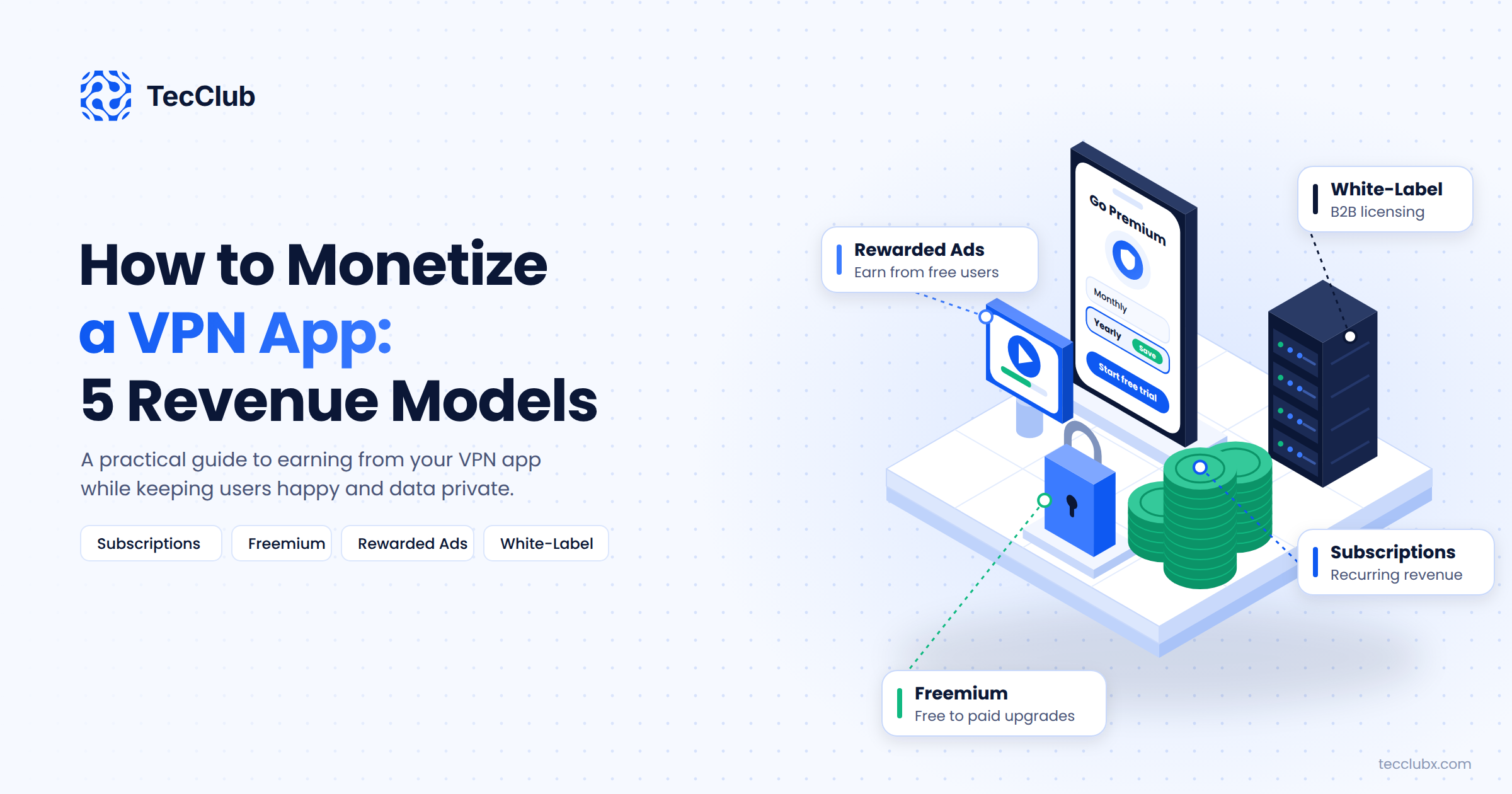
In this guide, we break down 5 proven ways to monetize a VPN app, explain how free VPNs actually make money, and help you pick the revenue model that fits your app and your audience. These insights come from building and running VPN apps used by over one million people.
How Do Free VPNs Make Money?
It is a fair question. Running a VPN is expensive. Every connection needs server capacity, bandwidth and regular maintenance. So how can an app offer all of this for free?
Most legitimate free VPNs make money in three ways:
- Ads: users see ads inside the app, usually before connecting or after disconnecting.
- Upgrades: the free version has limits, and a share of users pay to remove them.
- Rewarded access: users watch a short video ad to unlock extra time or premium servers.
Some free VPNs also sell or share user data with advertisers. This is the model you should avoid completely, and we explain why later in this guide.
The key point for app owners is simple: a free VPN is not really free. It is a funnel. Free users bring ad revenue, ratings and word of mouth, while a smaller group of paying users covers most of the server costs.
5 VPN App Monetization Models That Work
1. Subscriptions
Subscriptions are the most reliable VPN app revenue model. Users pay a recurring fee for full access, and you get predictable monthly income to plan your server costs.
Most VPN apps offer three plans: weekly, monthly and yearly. Weekly plans convert impulse buyers. Yearly plans bring the most value per customer and lower churn, so they are usually shown as the "best value" option with a visible discount.
Tips for better VPN subscription pricing:
- Offer a short free trial (3 or 7 days) so users can test speed before paying.
- Show the yearly plan first and highlight the saving as a percentage.
- Use Google Play Billing and Apple StoreKit, since both stores require their own billing for digital subscriptions in most cases.
- Send renewal reminders and keep cancellation simple. It reduces refund requests and negative reviews.
Best for: apps that focus on speed, privacy and reliability, and want stable long-term revenue.
2. Freemium with Limits
Freemium gives everyone a free version with clear limits and a paid version that removes them. It combines the reach of a free app with the income of a paid one.
Common limits in a freemium VPN app:
- Speed: free users get capped speed, premium users get full speed.
- Servers: a few free locations, with premium locations locked.
- Data or time: a daily data cap or a session time limit.
- Features: kill switch, split tunneling or streaming servers reserved for premium users.
The goal is balance. If the free version is too limited, users uninstall. If it is too generous, nobody upgrades. Start with one or two limits, track your free-to-paid conversion rate, and adjust over time.
Best for: new apps that need downloads and reviews quickly. A healthy free user base also supports your App Store Optimization, because more installs and ratings help your app rank higher.
3. Rewarded and Interstitial Ads
Ads let you earn from users who will never pay. For VPN apps, two ad formats work best:
- Rewarded ads: the user chooses to watch a short video in return for a reward, such as 60 extra minutes or one hour on premium servers. Users accept these well because they stay in control.
- Interstitial ads: full-screen ads shown at natural breaks, such as after connecting or disconnecting.
Avoid showing ads in the middle of a task or too often. Aggressive ads lead to one-star reviews, lower rankings and, in some cases, store policy warnings.
Also remember that ad revenue depends heavily on user location. Users in high-income countries earn far more per impression than users in other regions. If most of your users come from lower-paying markets, ads alone may not cover your server bills.
Best for: free apps with a large user base, usually combined with freemium or subscriptions.
4. Lifetime Plans and One-Time Purchases
A lifetime plan lets users pay once and use premium features forever. It appeals to users who dislike subscriptions, and it brings a large amount of cash upfront.
But it carries a real risk. Your server costs continue every month, while a lifetime user pays only once. If too many users choose lifetime access, future revenue shrinks while costs keep growing.
How to use lifetime plans safely:
- Price them at roughly 3 to 4 times your yearly plan.
- Offer them as a limited-time promotion, not a permanent option.
- Limit the number of devices per lifetime account.
Best for: raising quick cash for growth or rewarding loyal users, not as your main revenue source.
5. White-Label and B2B Licensing
Not all VPN revenue comes from app stores. Many businesses want their own branded VPN without building the technology from scratch. With white-label VPN licensing, you provide the app, the servers and the backend, and the client sells it under their own brand.
Common B2B models include:
- White-label apps: a ready-made VPN app rebranded with the client's name, logo and colors.
- Reseller plans: partners buy VPN accounts in bulk and resell them.
- Business VPN: secure access plans for teams and remote employees.
B2B deals are usually larger and more stable than individual subscriptions, and they make better use of server capacity you already run.
Best for: VPN providers with proven infrastructure who want a second, steady revenue stream.
What Not to Do: Selling User Data
Some VPN apps earn money by collecting browsing data and selling it to advertisers or data brokers. It may look like easy revenue, but it destroys the one thing a VPN actually sells: trust.
The risks are serious:
- Store rejection or removal: Apple's App Store guidelines do not allow VPN apps to sell or share user data with third parties, and Google Play has strict rules for apps that use the VpnService.
- Legal risk: privacy laws such as GDPR can lead to heavy fines.
- Brand damage: privacy-focused users and tech reviewers expose these practices quickly.
A clear no-logs policy is a selling point, not a cost. If you are preparing for launch, our guide on how to pass App Store and Google Play review for a VPN app explains these store rules in more detail.
Which VPN Monetization Model Fits Your App?
| Model | Revenue stability | Setup effort | Best for |
|---|---|---|---|
| Subscriptions | High | Medium | Apps with strong speed and reliability |
| Freemium | Medium to high | Medium | New apps that need fast growth |
| Rewarded and interstitial ads | Low to medium | Low | Large free user bases |
| Lifetime plans | Low (one-time) | Low | Quick cash and loyal users |
| White-label and B2B | High | High | Providers with proven infrastructure |
For most VPN apps, the strongest setup is a hybrid: a freemium app with rewarded ads for free users and subscriptions as the main upgrade path. Add white-label or B2B licensing once your infrastructure is stable.
Whichever model you choose, track a few numbers from day one: free-to-paid conversion rate, monthly churn, average revenue per user (ARPU) and ad revenue per thousand impressions (eCPM). Compare them with your server cost per active user. If revenue per user stays below that cost, adjust your limits, pricing or ad placement before you scale. These numbers show whether your monetization strategy is working long before your monthly server bill does.
If you are still at the idea stage, do not launch every model at once. Build an MVP with one clear paid plan, validate demand, then add more revenue streams step by step.
Final Thoughts
VPN app monetization is not about finding one perfect model. It is about matching your revenue strategy to your users, your markets and your server costs.
Start simple, measure conversion and churn, and protect user privacy at every step. Done right, your VPN app can grow into a sustainable business, not just another free download.
Planning to Launch Your Own VPN App?
TecClub builds custom and white-label VPN apps for Android, iOS and Flutter, with multi-protocol support and reliable server infrastructure. Our VPN products already serve over one million users.