Building a Subscription-Based VPN Business with White-Label Solutions
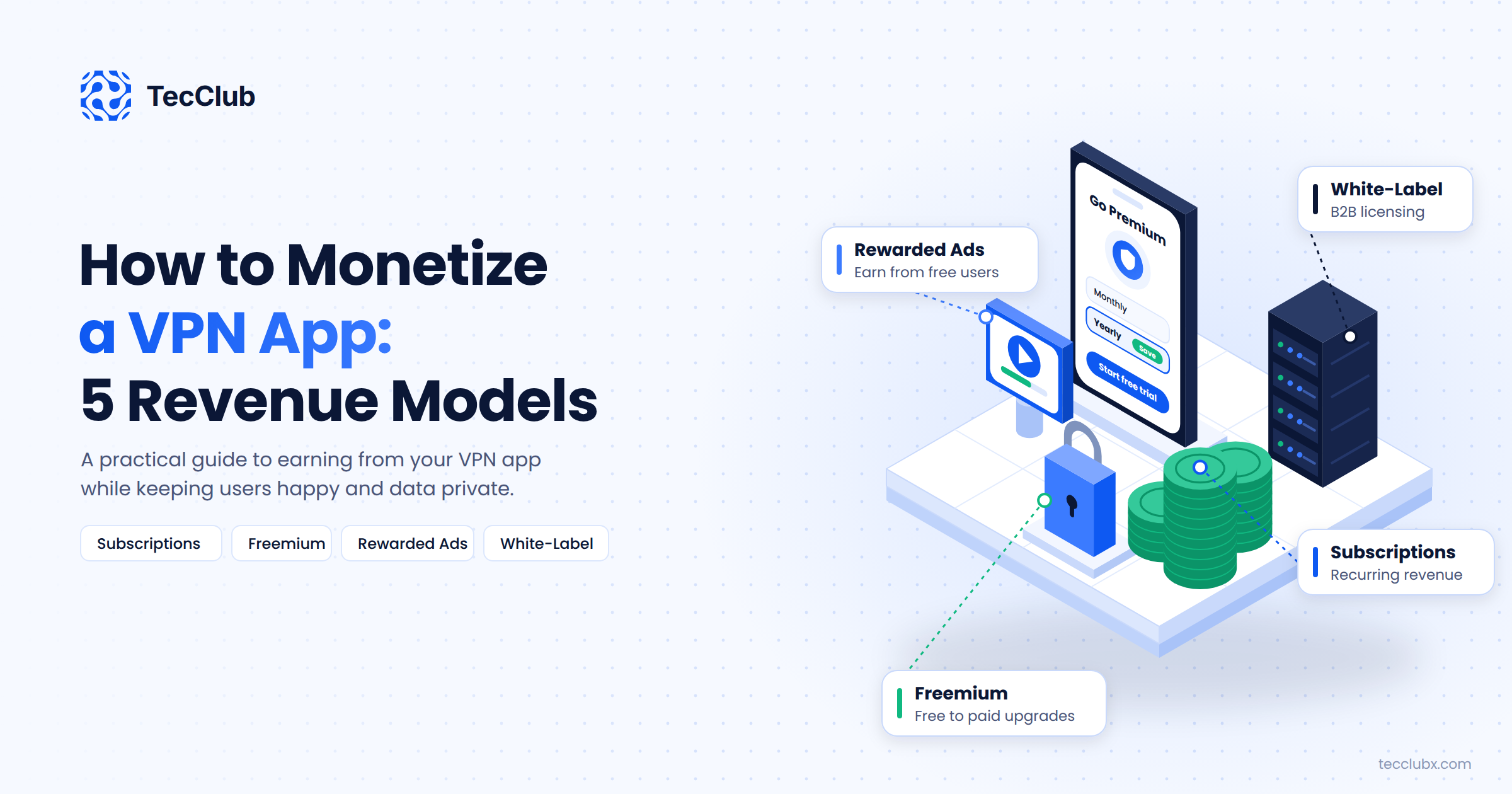
Starting a VPN business is about much more than simply launching an app and waiting for users to sign up. To build a successful and sustainable business, you need a model that can generate predictable revenue while keeping infrastructure and operational costs under control.
This is where a subscription-based VPN business model becomes especially valuable.
Instead of relying on one-time purchases, customers pay regularly to continue using your VPN service. When this model is combined with a white-label VPN solution, entrepreneurs and businesses can launch their own branded VPN service without having to build the entire technology stack from scratch.
At TecClub Technology, we help businesses build white-label VPN platforms with branded applications, backend infrastructure, subscription management, APIs, and scalable server architecture.
Let's take a closer look at how a subscription-based VPN business works and how white-label technology can make the journey easier.
1. Understanding the Subscription-Based VPN Model
The basic idea behind a subscription-based VPN business is simple:
VPN Infrastructure → Your Brand → Subscription Plans → Customers → Recurring Revenue
Your customers choose a subscription plan and pay regularly for continued access to your VPN service.
Common subscription options may include:
-
Monthly plans
-
Quarterly plans
-
Six-month plans
-
Annual plans
-
Family plans
-
Business plans
-
Enterprise plans
As long as customers continue renewing their subscriptions, the business continues generating recurring revenue.
Of course, revenue and profit are not the same thing. A profitable VPN business also needs to manage costs such as infrastructure, payment processing, customer support, marketing, server expenses, and ongoing app maintenance.
The goal is to create a business model where recurring revenue grows in a sustainable way while costs remain manageable.
2. Why White-Label Solutions Make Launching Easier
Building a VPN platform from scratch can be technically demanding. It may require expertise in:
-
Mobile app development
-
Desktop app development
-
VPN protocols
-
Backend development
-
Server infrastructure
-
API development
-
Authentication
-
Subscription systems
-
Monitoring
-
Security
-
DevOps and maintenance
Building all of this independently can take considerable time, investment, and technical resources.
A white-label VPN solution provides an existing technology foundation that businesses can customize and launch under their own brand.
Depending on the provider and package, this can include:
-
Branded VPN applications
-
Backend infrastructure
-
Admin dashboard
-
User management
-
Subscription management
-
VPN APIs
-
Server deployment
-
Multi-protocol support
-
Monitoring tools
This means you don't have to spend months building every core component before entering the market. Instead, you can start with an established foundation and focus more of your time and budget on growing the business.
3. Create Subscription Plans Around Your Target Audience
Your subscription plans should make sense for the people you want to serve.
A consumer-focused VPN, for example, might offer:
Basic Plan
A simple and affordable option for individual users who need VPN access on a limited number of devices.
Premium Plan
A higher-tier plan that may include additional devices, more server locations, or advanced features.
Annual Plan
A longer-term subscription that gives customers a better effective monthly price while helping the business improve cash flow.
A business-focused VPN may take a different approach and create plans based on:
-
Number of users
-
Number of devices
-
Dedicated infrastructure
-
Administrative controls
-
Additional security features
The important thing is to keep your plans clear and easy to understand. Too many confusing options can make it harder for customers to decide.
4. Connect Payments With VPN Access
A smooth subscription-based VPN business needs to connect payments directly with user access.
A typical process may look like this:
User selects a plan
↓
Payment is processed
↓
Backend confirms the subscription
↓
VPN access is activated
↓
Subscription remains active until renewal or expiration
The backend can manage different account statuses, such as:
-
Active
-
On a trial
-
Expired
-
Cancelled
-
Suspended
-
Pending payment
This connection between billing and access is important because it allows the system to manage customers automatically.
As your customer base grows, automation can save a significant amount of time and reduce the need for manual account management.
5. Automate Subscription Management
Managing ten customers manually might be manageable.
Managing hundreds or thousands of customers is a completely different challenge.
A well-designed white-label VPN platform should ideally automate processes such as:
-
Account creation
-
Plan activation
-
Subscription validation
-
Renewals
-
Expiration
-
Device limits
-
Upgrades
-
Downgrades
-
Trial periods
-
Payment status updates
Automation allows the business to grow without requiring administrators to manually manage every customer account.
It also creates a smoother experience for users because access, renewals, and subscription updates can happen automatically in the background.
6. Focus on Monthly Recurring Revenue
One of the biggest advantages of a subscription-based business is predictable recurring income.
For example:
200 customers × $8/month = $1,600 in monthly recurring revenue
As the customer base grows:
1,000 customers × $8/month = $8,000 in monthly recurring revenue
However, it's important to remember that these examples represent revenue, not profit.
Your actual profitability depends on factors such as:
-
Infrastructure costs
-
Server and bandwidth expenses
-
Payment processing fees
-
Customer support
-
Marketing costs
-
App maintenance
-
Customer acquisition costs
The goal is to build a model where the long-term value of a customer is greater than the cost of acquiring and serving that customer.
That is where a subscription business can become increasingly valuable over time.
7. Use Annual Plans to Improve Cash Flow
Monthly subscriptions give customers flexibility, but annual plans can also provide important benefits for the business.
Annual subscriptions can:
-
Improve upfront cash flow
-
Increase customer commitment
-
Potentially reduce churn
-
Make revenue more predictable
Many subscription businesses encourage customers to choose annual plans by offering a lower effective monthly price compared with paying month-to-month.
However, the discount you offer should always make sense for your margins and overall business strategy.
The goal is not simply to make the annual plan cheaper, but to create enough value that customers see it as a better long-term option.
8. Customer Retention Is Critical
Getting new customers is important, but keeping existing customers can be just as important—if not more.
If users constantly subscribe and cancel after one month, the business has to keep spending money to replace them.
Improving retention can involve:
-
Stable VPN connections
-
Fast server performance
-
A simple user experience
-
Reliable customer support
-
Transparent pricing
-
Easy subscription management
-
Regular app updates
A strong product and a positive customer experience can often have just as much impact on long-term growth as marketing.
When customers are satisfied with the service, they are more likely to renew their subscriptions and continue using your VPN over time.
9. Monitor Churn and Subscription Performance
To understand whether your VPN business is growing in a sustainable way, it's important to track the right metrics.
Useful metrics can include:
-
Active subscribers
-
New subscribers
-
Monthly recurring revenue
-
Renewal rate
-
Cancellation rate
-
Churn rate
-
Average revenue per user
-
Customer acquisition cost
-
Customer lifetime value
These numbers can help you understand where the biggest opportunities and challenges are.
For example, if you are gaining many new customers but losing them quickly, improving retention may be more valuable than simply increasing your marketing budget.
Data can help you make smarter decisions instead of relying only on assumptions.
10. Build a Scalable Infrastructure
Your infrastructure needs will change as your VPN business grows.
A scalable VPN platform should make it easier to:
-
Add more users
-
Deploy additional servers
-
Expand into new regions
-
Handle higher traffic
-
Monitor server performance
-
Balance workloads
Tools such as load balancing, real-time monitoring, and intelligent server selection can help maintain performance as demand increases.
The key is to scale based on actual usage rather than spending heavily on infrastructure before you have enough customers to justify it.
A flexible infrastructure allows you to grow gradually while keeping operational costs under better control.
11. Choose the Right Target Market
A VPN business doesn't necessarily need to target everyone.
In many cases, focusing on a specific audience can make branding, pricing, features, and marketing much easier.
You might build a VPN service for:
-
Individual privacy-focused users
-
Remote workers
-
Travelers
-
Small businesses
-
Digital agencies
-
Managed IT providers
-
SaaS customers
-
Specific geographic markets
A clear target audience gives you a better understanding of what your customers actually need.
For example, a VPN designed for businesses may require administrative controls and team management, while a consumer-focused VPN may prioritize simplicity, speed, and multi-device access.
12. Differentiate Your VPN Brand
White-label technology gives you the technical foundation, but technology alone isn't always enough to make customers choose your service.
Your brand still needs a clear reason to stand out.
You can differentiate your VPN through:
-
A better customer experience
-
A specific target market
-
Unique pricing
-
Business-focused features
-
Multi-device plans
-
Dedicated support
-
Specialized integrations
-
Regional server availability
The underlying technology may be shared or based on reusable infrastructure, but your brand strategy and customer experience can make the business feel completely different.
This is why branding, positioning, and understanding your audience remain important even when you are using a white-label solution.
13. Keep Infrastructure Costs Under Control
Infrastructure is one of the main ongoing costs of running a VPN service.
As your business grows, regularly monitor:
-
Server usage
-
Bandwidth consumption
-
Active connections
-
Regional demand
-
Server load
Adding more servers without understanding actual demand can increase your costs unnecessarily.
A good infrastructure strategy focuses on finding the right balance between:
Performance + Capacity + Operating Costs
The goal is to provide a reliable experience for users without overinvesting in resources that aren't yet needed.
As demand grows, your infrastructure can expand alongside it.
14. Use an Admin Dashboard to Manage the Business
As the number of customers increases, managing everything manually becomes more difficult.
A centralized admin dashboard can simplify daily operations by giving your team access to important business and technical information in one place.
Depending on the platform, you may be able to manage:
-
Users
-
Subscription plans
-
Active accounts
-
Expired accounts
-
Devices
-
Servers
-
VPN configurations
-
Support activity
-
Business analytics
This becomes increasingly valuable as your customer base expands.
Instead of switching between multiple systems, administrators can manage key parts of the VPN business from a centralized interface.
A Simple Subscription-Based VPN Business Roadmap
Here is a practical path for launching a subscription-based VPN business.
Step 1: Define Your Target Market
Start by deciding exactly who your VPN service is designed for.
Understanding your audience will influence your pricing, features, branding, and marketing strategy.
Step 2: Choose a White-Label VPN Solution
Select a provider that offers the infrastructure, applications, flexibility, and technical capabilities your business needs.
Step 3: Build Your Brand
Create your:
-
Brand name
-
Logo
-
Website
-
App identity
-
Customer messaging
Your brand should feel professional, clear, and consistent across every customer touchpoint.
Step 4: Customize Your Applications
Prepare your VPN applications for the platforms you want to support and customize them to reflect your brand.
Step 5: Create Subscription Plans
Decide which monthly, annual, business, or other subscription options make sense for your target audience.
Step 6: Integrate Payment Systems
Connect your payment workflow with your subscription management system so that payments and VPN access work together smoothly.
Step 7: Configure the Backend
Set up the systems responsible for user authentication, subscription validation, device management, and VPN access controls.
Step 8: Test Everything
Before launch, test important areas such as:
-
Payments
-
Account activation
-
VPN connections
-
Subscription expiration
-
Renewals
-
Device limits
-
Network performance
Testing before launch can help identify issues before they affect real customers.
Step 9: Launch and Acquire Customers
Once the platform is ready, focus on marketing, partnerships, content, and customer acquisition.
Step 10: Monitor, Improve, and Scale
Use customer feedback, performance data, and business analytics to improve the service and expand infrastructure when demand requires it.
The best approach is usually to grow based on real customer needs rather than assumptions.
How TecClub Technology Helps Build Subscription-Based VPN Businesses
At TecClub Technology, we provide flexible VPN solutions for businesses that want to launch their own branded subscription service.
Our solutions can include:
-
White-label VPN applications
-
Android and iOS support
-
Windows and macOS applications
-
Secure backend infrastructure
-
VPN APIs
-
Admin dashboards
-
Subscription management
-
User and device management
-
Multi-protocol support
-
Server deployment
-
Real-time monitoring
-
Performance optimization
-
Ongoing technical support
Businesses can start with the components they actually need and expand the platform as their customer base grows.
This approach gives businesses more flexibility instead of forcing them to invest in technology or features they may not need at the beginning.
Final Thoughts
Building a subscription-based VPN business is not simply about selling VPN access.
Long-term success depends on providing a reliable service, managing recurring subscriptions efficiently, keeping operating costs under control, and giving customers a strong reason to continue renewing.
White-label VPN solutions can reduce much of the technical complexity involved in launching by providing an existing foundation for applications, infrastructure, backend systems, and subscription management.
This allows entrepreneurs and businesses to spend more time focusing on what truly drives growth:
Building a trusted brand, acquiring customers, improving retention, and creating sustainable recurring revenue.
For businesses looking to enter the VPN market without building the entire technology stack from scratch, a scalable white-label solution can provide a practical and flexible starting point.
At TecClub Technology, we help businesses build branded, subscription-based VPN platforms with the infrastructure, applications, backend systems, and flexibility needed to launch confidently and grow over time.