
How to Build a Profitable VPN Business with White-Label Technology
Starting a VPN business can sound like a huge technical project. You might imagine needing to build VPN apps from scratch, set up servers around the world, create a backend, manage different protocols, handle subscriptions, and keep the entire infrastructure running smoothly.
And honestly, building everything yourself can be complex and expensive.
But that doesn't mean you have to start from zero.
With white-label VPN technology, businesses can use an existing technology foundation, customize it with their own branding, and focus more of their time and budget on growing the business.
Instead of spending months building every part of the platform, you can start with the infrastructure you need and concentrate on the things that directly impact your success—such as branding, customer acquisition, retention, and recurring revenue.
At TecClub Technology, we help businesses launch and grow their own branded VPN services with scalable infrastructure, custom applications, backend systems, and subscription management.
So, let's look at how you can build a profitable VPN business using white-label technology.
1. Understand How the VPN Business Model Works
Before thinking about apps, servers, or features, it's important to understand how the business itself works.
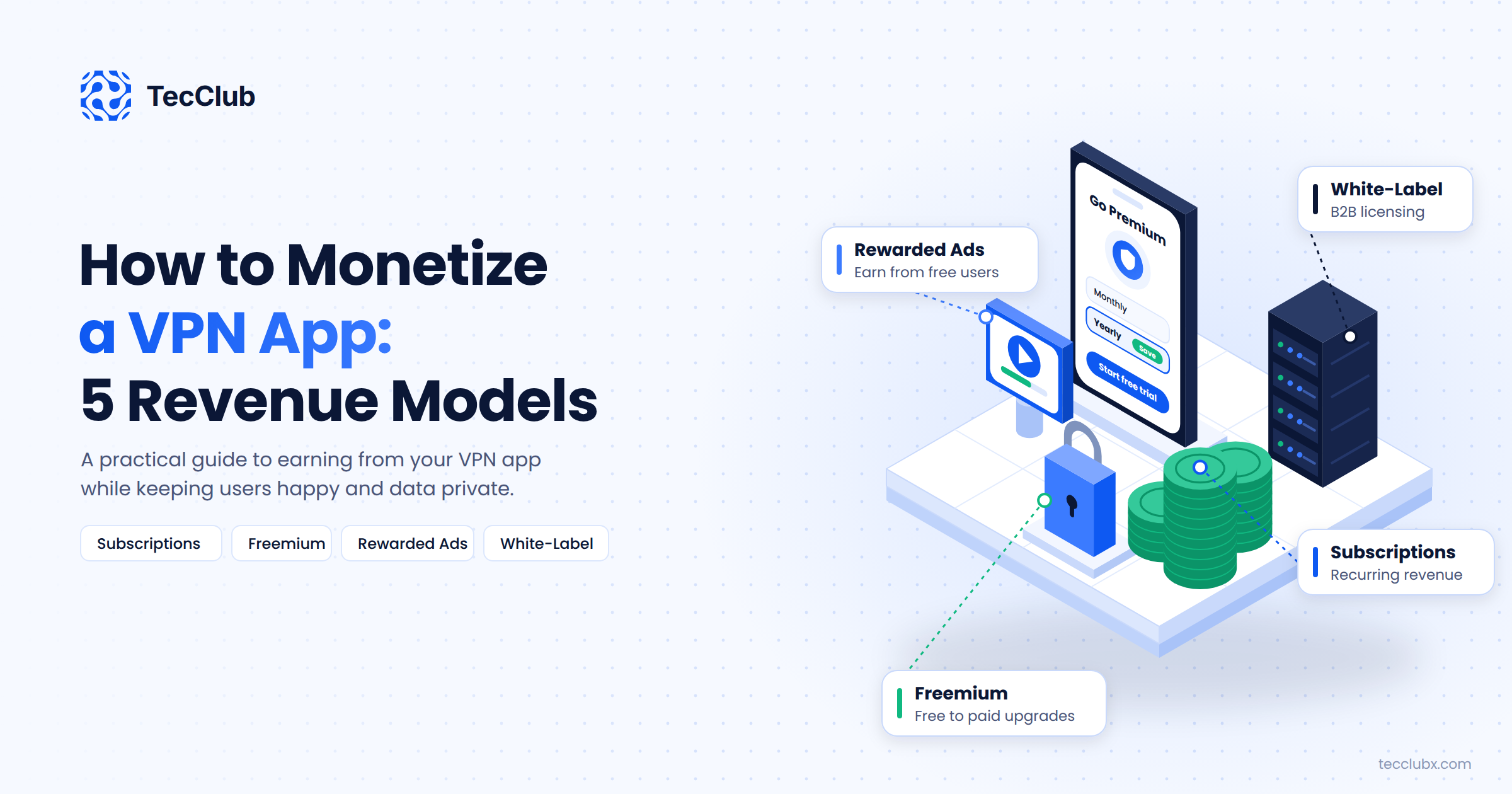
Most VPN businesses operate on a subscription-based model.
The basic flow looks something like this:
Infrastructure Provider → Your VPN Brand → Paying Customers
The infrastructure provider handles the technology behind the service, while you build your own brand and sell VPN subscriptions to customers.
Those subscriptions might include:
-
Monthly plans
-
Quarterly plans
-
Annual plans
-
Family plans
-
Business plans
-
Enterprise packages
Your business earns revenue from the customers who subscribe to your service.
Of course, revenue alone doesn't equal profit. You still need to account for infrastructure costs, bandwidth, payment processing, marketing, customer support, maintenance, and other operating expenses.
The goal is to build a business where the money you earn from customers is greater than the total cost of acquiring and serving them.
2. Choose the Right Target Market
One common mistake new VPN businesses make is trying to target everyone.
The VPN market is broad, and different users have different needs. A remote worker may care most about secure access and reliability, while a traveler may value global server locations. A business may need centralized management, while mobile users may simply want a fast and easy connection.
That's why it's usually better to start by identifying a clear target audience.
For example, you might focus on:
-
Privacy-focused consumers
-
Remote workers
-
Small businesses
-
Travelers
-
Digital agencies
-
Enterprise teams
-
Specific regional markets
-
Gamers or mobile-first users
Once you understand who you're building for, it becomes much easier to make decisions about pricing, features, branding, and marketing.
You don't necessarily need to serve everyone on day one. Start with the audience you understand best and expand as the business grows.
3. Use White-Label Technology to Reduce Startup Costs
Building a complete VPN platform from scratch involves much more than designing an app.
You may need to invest in:
-
Mobile app development
-
Desktop applications
-
Backend development
-
Server infrastructure
-
VPN protocol implementation
-
User authentication
-
APIs
-
Admin dashboards
-
Subscription systems
-
Testing
-
Security
-
Ongoing maintenance
Each of these areas requires time, technical expertise, and financial investment.
With a white-label VPN solution, much of the core technology is already available. Instead of building every component from the beginning, you can customize an existing platform around your business.
That means you can direct more of your initial budget toward areas such as:
-
Branding
-
Marketing
-
Customer acquisition
-
Customer support
-
Product positioning
-
Market expansion
Reducing unnecessary development costs doesn't automatically guarantee profitability, but it can help businesses launch with less upfront investment and reach the market sooner.
4. Build a Brand That Customers Can Trust
When people use a VPN, they're trusting the service with an important part of their online activity. That means your brand matters.
Simply taking a generic app and placing your logo on it may not be enough to create a strong customer experience.
Your VPN should feel like a complete and professional product.
With white-label technology, you can customize elements such as:
-
App name
-
Logo
-
App icon
-
Brand colors
-
Website
-
Landing pages
-
Onboarding experience
-
Customer emails and communication
Consistency is important.
When your website, applications, support channels, and marketing all reflect the same brand identity, the business feels more established and trustworthy.
In a competitive VPN market, a strong brand can sometimes be just as important as adding another technical feature.
5. Offer the Right Features
It's tempting to launch with every feature imaginable, but that isn't always the best approach.
More features can also mean more complexity, more testing, and more maintenance.
A better starting point is to focus on what your target customers actually need.
Essential VPN features may include:
-
Fast and stable connections
-
Multiple server locations
-
Automatic server selection
-
Secure authentication
-
Kill switch functionality
-
DNS leak protection
-
Multi-device support
-
Auto-connect
-
Split tunneling
Once your customer base grows and you understand how people are using your service, you can introduce additional features.
These might include:
-
Dedicated IP addresses
-
Business accounts
-
Custom routing
-
Advanced server selection
-
Additional security tools
-
Enterprise management features
Start with a strong core product, then improve it based on real customer needs rather than adding features just for the sake of having them.
6. Support Multiple VPN Protocols
Not every user connects to the internet in the same way.
Different devices, operating systems, and network environments may work better with different VPN protocols. Supporting multiple options can give your platform more flexibility.
Depending on your infrastructure, you may support technologies such as:
-
WireGuard
-
OpenVPN
-
IKEv2/IPSec
-
VLESS
-
Shadowsocks
The goal isn't necessarily to offer every protocol available. It's to provide the options that make sense for your users and business requirements.
A flexible VPN architecture can make it easier to support different connectivity needs without building separate systems for every protocol.
Modern networking technologies such as Sing-box can also help support flexible configurations and multi-protocol environments.
7. Create a Smart Pricing Strategy
A profitable VPN business isn't simply about charging the lowest price.
In fact, competing only on price can make it difficult to maintain quality infrastructure and customer support.
Your pricing needs to account for costs such as:
-
Infrastructure
-
Servers and bandwidth
-
Payment processing
-
App maintenance
-
Customer support
-
Marketing
-
Ongoing development
At the same time, customers need to clearly understand the value they're getting.
A simple pricing structure might include:
Basic Plan
A straightforward option for users who need standard VPN access.
Premium Plan
A higher-tier option that may include more devices, additional locations, or advanced features.
Business Plan
Designed for teams or organizations that need multiple accounts, centralized management, or additional controls.
Annual subscriptions can also be useful because they encourage longer-term customer relationships and can improve cash flow.
The key is to create pricing that makes sense for both your customers and your business.
8. Focus on Recurring Revenue
One of the biggest advantages of the VPN business model is recurring revenue.
Instead of relying on customers to make a one-time purchase, subscription-based services can generate revenue every month or year as long as customers continue using the service.
For example:
100 customers × $10 per month = $1,000 in monthly recurring revenue
As the customer base grows:
500 customers × $10 per month = $5,000 in monthly recurring revenue
However, it's important to remember that revenue is not the same as profit.
You still need to subtract costs related to infrastructure, payment processing, marketing, customer support, maintenance, and other operations.
The real goal is to build a sustainable business where the lifetime value of a customer is greater than the cost of acquiring and serving that customer.
That's where retention becomes especially important.
9. Make Subscription Management Automatic
Managing a few subscriptions manually might be possible.
Managing hundreds or thousands of customers manually is not.
As your VPN business grows, automation becomes essential.
A good white-label VPN platform should be able to handle processes such as:
-
User registration
-
Plan selection
-
Payment confirmation
-
Account activation
-
Subscription renewals
-
Expiration handling
-
Device limits
-
Upgrades and downgrades
For example, when a customer successfully completes a payment, the backend can automatically activate their account and give them access to the VPN.
When a subscription expires, the system can update the account status accordingly.
This reduces administrative work and creates a smoother experience for customers.
10. Keep Infrastructure Costs Under Control
Infrastructure is one of the major ongoing expenses in a VPN business.
As more users join your platform, you may need to increase server capacity, bandwidth, and monitoring resources.
But scaling doesn't mean adding servers everywhere without a plan.
It's important to monitor actual demand.
Keep an eye on:
-
Server usage
-
Bandwidth consumption
-
Active connections
-
Server load
-
Regional demand
-
Connection performance
If a particular location is consistently under heavy load, it may make sense to increase capacity there.
On the other hand, maintaining expensive infrastructure in regions with very little demand may not be the best use of resources.
Features such as load balancing and smart server selection can also help distribute traffic more efficiently.
The goal is to scale based on real usage, not assumptions.
11. Focus on Customer Retention
Getting someone to subscribe is only the beginning.
The real value comes when customers continue using your VPN service month after month.
Acquiring new customers often requires spending money on marketing, advertising, partnerships, or sales. Keeping existing customers satisfied can be a more efficient way to build long-term revenue.
To improve customer retention, focus on:
-
Stable connections
-
Fast performance
-
A simple user experience
-
Reliable customer support
-
Transparent pricing
-
Easy subscription management
-
Regular app improvements
A customer who stays with your service for 12 months is generally much more valuable than someone who subscribes once and cancels after the first month.
That's why reducing churn should be a major part of your profitability strategy.
12. Use Analytics to Make Better Decisions
Running a VPN business without data can make growth much harder.
Analytics can help you understand what's working, where customers are struggling, and where your money is actually going.
Useful metrics may include:
-
New subscriptions
-
Active subscribers
-
Renewal rate
-
Churn rate
-
Most popular plans
-
Customer acquisition cost
-
Average revenue per user
-
Server performance
-
Connection success rate
For example, if one subscription plan performs significantly better than the others, that may influence your pricing strategy.
If users in a particular region experience slower connections, you may need to review your infrastructure in that location.
Analytics should help guide decisions about both the technical platform and the business itself.
13. Scale Gradually
You don't need to launch with hundreds of servers and a massive global infrastructure.
For many businesses, a more practical approach is:
Launch → Test the Market → Acquire Customers → Analyze Demand → Scale
Start with the infrastructure and features you actually need.
As the business grows, you can gradually:
-
Add more server locations
-
Increase capacity
-
Launch on additional platforms
-
Introduce new subscription plans
-
Add advanced features
-
Enter new markets
White-label technology can make this process easier because you're building on an existing foundation rather than rebuilding the entire platform every time your business expands.
Growing gradually also gives you time to learn what your customers actually want.
14. Choose a Flexible White-Label Partner
Every VPN business is different.
Some companies may only need:
-
VPN infrastructure
-
Backend systems
-
API access
Others may need a complete solution that includes:
-
Android and iOS applications
-
Windows and macOS apps
-
Admin dashboard
-
Subscription management
-
Server infrastructure
-
Custom branding
-
Ongoing maintenance
The right technology partner should offer enough flexibility to match your business requirements.
You shouldn't necessarily have to invest in features or infrastructure you don't need.
At the same time, your platform should be able to expand when your business does.
A flexible setup allows you to start with what makes sense today and add more capabilities as your customer base and requirements grow.
How TecClub Technology Helps Build VPN Businesses
At TecClub Technology, we help businesses launch and scale their own branded VPN services without requiring them to build every part of the technology from scratch.
Our white-label VPN solutions can include:
-
Custom-branded VPN applications
-
Android, iOS, Windows, and macOS support
-
Multi-protocol connectivity
-
Secure backend infrastructure
-
Admin dashboards
-
API integration
-
Subscription management
-
User and device management
-
Server deployment
-
Real-time monitoring
-
Performance optimization
-
Ongoing technical support
Businesses can start with the infrastructure and features they need, then expand as their customer base grows.
The goal is to provide a flexible technology foundation so businesses can spend less time worrying about complex infrastructure and more time focusing on their customers and growth.
A Simple Roadmap to Profitability
Building a profitable VPN business doesn't happen overnight, but having a clear process can make the journey easier.
A practical roadmap could look like this:
Step 1: Choose your target market.
Understand who you want to serve and what problems your VPN will solve for them.
Step 2: Select a white-label VPN technology partner.
Choose a solution that provides the infrastructure, flexibility, and support your business needs.
Step 3: Build your brand and customize the apps.
Create a professional identity that customers can recognize and trust.
Step 4: Set up subscription plans and payment systems.
Choose pricing that works for your customers while supporting a sustainable business model.
Step 5: Launch with the essential features.
Avoid overcomplicating the first version of your product.
Step 6: Start acquiring customers.
Focus your marketing efforts on the audience you've identified.
Step 7: Monitor revenue, churn, and infrastructure costs.
Understand where your business is making money and where costs need to be optimized.
Step 8: Improve customer retention and experience.
Listen to feedback, improve performance, and make the service easier to use.
Step 9: Scale infrastructure based on real demand.
Add capacity and locations as your customer base grows.
Step 10: Expand into new markets and services.
Once the core business is stable, explore new regions, features, plans, and customer segments.
The key is to avoid overinvesting before you've validated your market.
Start with a solid foundation, learn from your customers, and scale based on real demand.
Conclusion
Building a profitable VPN business doesn't necessarily mean developing every piece of technology from scratch.
White-label VPN technology can provide a practical starting point by reducing development effort, shortening the time to market, and giving businesses more room to focus on the areas that actually drive growth—branding, customer acquisition, customer retention, and recurring revenue.
Of course, technology alone won't make a VPN business profitable. Success also depends on understanding your target audience, managing infrastructure costs, creating a strong customer experience, and keeping customers subscribed over the long term.
The most practical approach is to start with the right technology foundation, launch with a clear business strategy, monitor what happens after launch, and scale as real customer demand grows.
At TecClub Technology, we help businesses launch and grow white-label VPN services with scalable infrastructure, custom applications, backend systems, and flexible solutions designed around their specific business goals.