Hiring the wrong developer for a normal app costs you time and money. Hiring the wrong developer for a VPN app can cost you much more: an app that gets rejected by Apple, connections that fail in the countries you want to sell in, or a privacy problem that ends your brand before it starts.
VPN apps are a narrow specialty. A team can be great at e-commerce apps and still have no idea how VpnService, NetworkExtension, WireGuard or VLESS behave in the real world. So before you sign with any VPN app development company, it pays to ask the right questions.
We build VPN apps for clients and run our own, so we sit on both sides of this conversation. Below are the 10 questions we would ask if we were in your place, what a good answer sounds like, and the red flags to watch for.
1. Which VPN apps have you built that are live right now?
This is the most important question, so ask it first. Screenshots and Dribbble shots are easy to make. A live app on Google Play or the App Store, with real users and real reviews, is not.
Ask for store links, then install the apps yourself. Connect, switch servers, put your phone on mobile data and see if it reconnects. Check when each app was last updated. A good partner will happily share links to client apps they are allowed to show, plus their own products if they have any.
Red flag: only design mockups, or "all our VPN work is under NDA" with nothing live to show at all.
2. Which VPN protocols have you shipped in production?
Every VPN company says it supports "all protocols". What you want to know is which ones they have actually put in front of users and kept working through updates.
A strong team will talk comfortably about WireGuard for speed, OpenVPN and IKEv2 for compatibility, and newer options such as VLESS with Reality, Hysteria2 or Shadowsocks for networks that block standard VPN traffic. They should also be able to explain why they would pick one over another for your audience, not just list names. If you are not sure which protocol fits you, our guide on what makes VLESS different from traditional VPN protocols is a good starting point.
Red flag: a long list of protocols with no clear answer on which one they would recommend for your users, and why.
3. Have you passed App Store and Google Play review for VPN apps?
VPN apps get extra attention in review. Apple wants the app published by an organization account, a clear privacy policy and honest subscription terms. Google wants a VpnService declaration and a Data safety section that matches what the app really collects. Many first-time VPN apps get rejected two or three times before they go live.
Ask how many VPN apps they have taken through review, what the most common rejection reasons were, and how they fixed them. A team that has done this before will answer without guessing. We wrote a full checklist on how to pass App Store and Google Play review for a VPN app if you want to compare their answers.
4. Native, Flutter or something else, and why?
There is no single right answer, but there should be a clear reason. Native apps (Kotlin on Android, Swift on iOS) give full control over the VPN layer. Flutter can save time and money on the interface, but the VPN tunnel itself still needs native code on each platform.
Ask how they handle the tunnel part on each platform and how they keep both apps consistent. If they say Flutter does everything, including the tunnel, with no native code at all, keep asking questions.
5. Who builds the backend, and what does it include?
The app is only the front door. Behind it you need user accounts, subscription checks, server lists, configuration delivery and an admin panel. Some companies only build the app and leave you to find someone else for the rest.
Ask exactly what is included: an admin panel to manage users and servers, an API that hands out server configs, subscription verification on the server, and basic reporting. Get it in writing in the proposal, line by line.
6. How do you verify subscriptions?
This sounds like a small detail. It is not. If premium access is only checked inside the app, anyone with a modified APK gets your paid servers for free.
The right answer is that purchases are verified on the server through the App Store Server API and Google Play Developer API, with store notifications turned on for renewals, cancellations and refunds. If the team has not heard of server notifications, that tells you a lot.
7. How will the app handle no-logs and user privacy?
Your users choose a VPN to protect their privacy. If your app quietly ships with an analytics or ad SDK that collects IP addresses, you have a trust problem and possibly a store compliance problem too.
Ask what data the app and backend will store, which third-party SDKs they plan to include, and how they will fill in the App Store privacy labels and the Google Play Data safety form. Good teams keep the SDK list short and can explain every item on it.
8. How do you test VPN connections before release?
A VPN app that works on office Wi-Fi can still fail on mobile networks, behind captive portals or in countries with filtering. Ask how they test:
- Switching between Wi-Fi and mobile data while connected
- DNS, IPv6 and WebRTC leak tests
- Kill switch behavior when the tunnel drops
- Connections from the regions where your users live
- Battery use over a full day of being connected
Ask to see a test checklist from a past project. It is a fast way to tell process from promises.
9. What happens after launch?
VPN apps need regular care. Android and iOS release new versions every year, stores change their policies, and networks change how they block VPN traffic. A protocol that works today may need tuning in three months.
Ask what support looks like after launch: response times, monthly maintenance options, who monitors your servers, and how fast they can ship a fix if connections start failing in one country. Monitoring matters more than most founders expect. Tools like ExitProbe for VPN server monitoring can catch a failing protocol before your users do.
10. Who owns the code and the accounts?
Get this clear before you pay anything. You should own the source code, the store developer accounts, the domain, the servers and the admin panel. The developer should work inside your accounts, not theirs.
Red flag: the app is published under the developer's own store account "to save time". Moving an app between accounts later is slow, and in some cases you lose your reviews and rankings.
A Quick Way to Compare Proposals
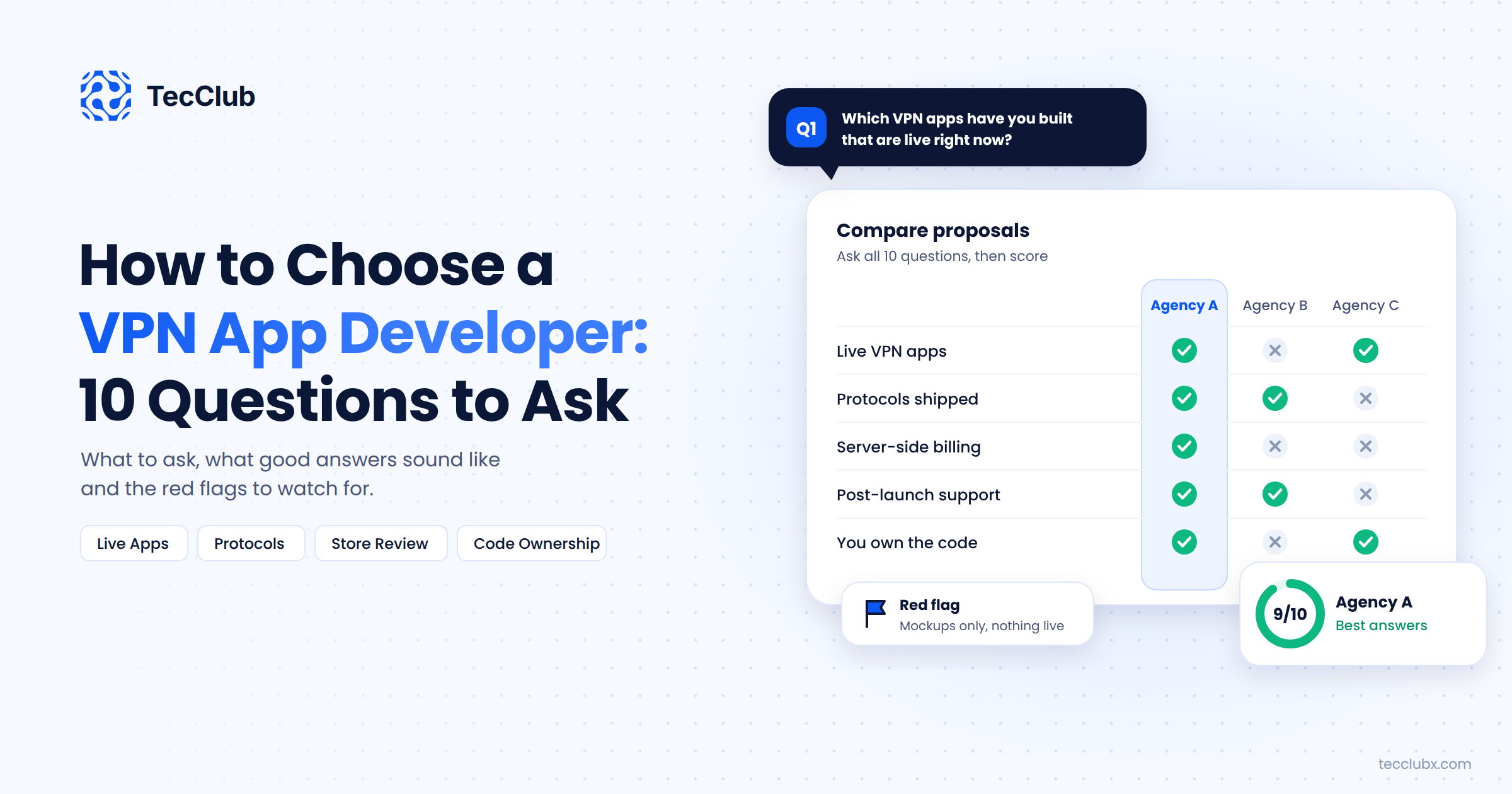
Once you have answers from two or three companies, put them side by side. Price matters, but look closer at these four things: live VPN apps you tested yourself, protocols matched to your audience, a backend with server-side subscription checks, and a clear support plan after launch. A cheaper quote that is missing one of these usually costs more in the end.
Also check whether the plan fits your timeline. If you want to test the market first, ask for a smaller first version with one or two protocols and a basic panel, then grow from there.
Final Thoughts
The right VPN app development company will not just say yes to everything. They will ask about your users, your target countries and your business model before they talk about features. They will show you live apps, explain their protocol choices in plain words, and be clear about what happens after launch.
Use these 10 questions in your next call. The answers will tell you very quickly who has really built and run VPN apps, and who is learning on your budget.
Planning a VPN App?
TecClub builds VPN apps for Android, iOS and Flutter with WireGuard, OpenVPN, IKEv2, VLESS/Reality and Hysteria2, plus the backend and admin panel behind them. Ask us any of the 10 questions above. We are happy to answer them all.
Talk to our team about your VPN app or email us at [email protected].