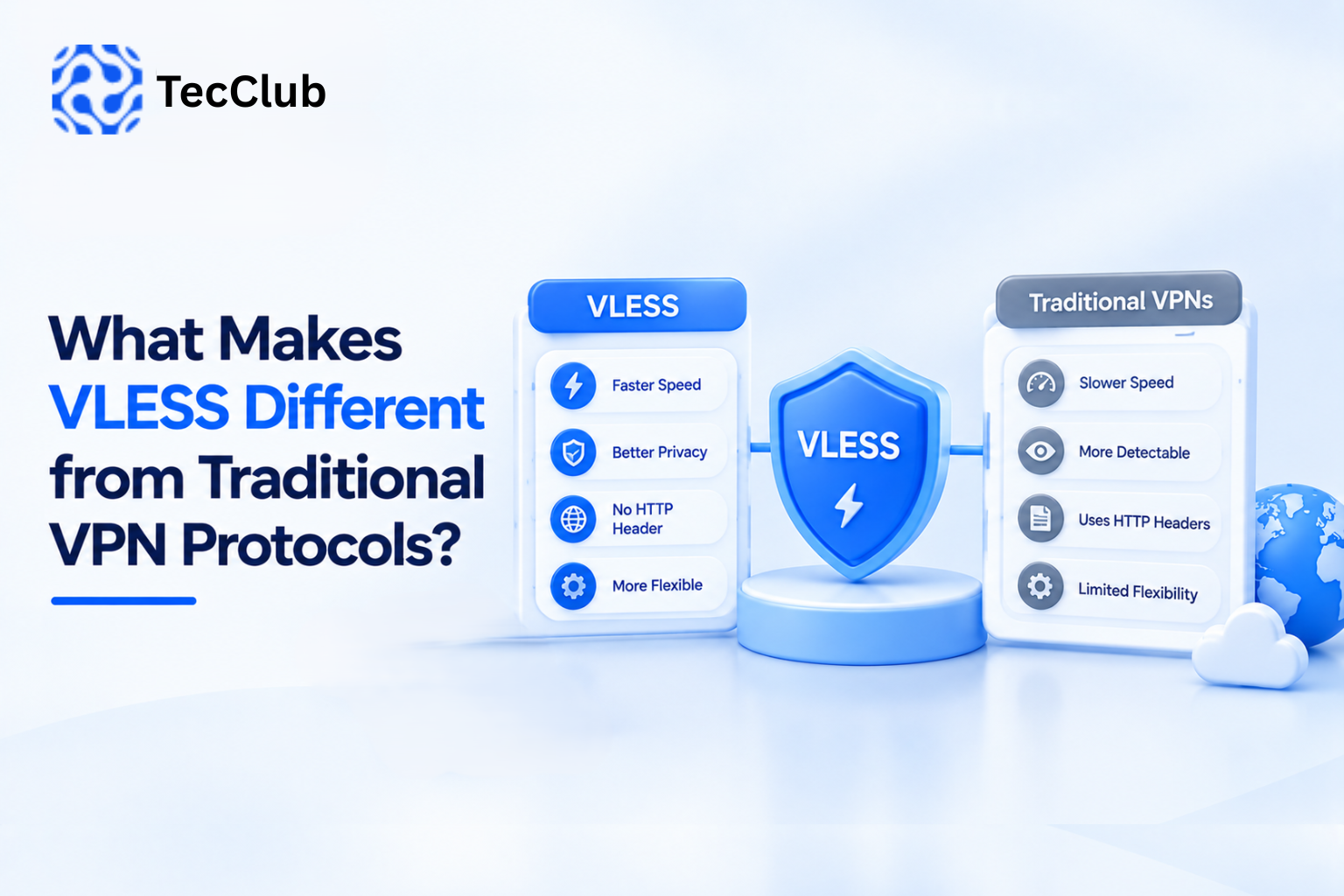
What Makes VLESS Different from Traditional VPN Protocols?
Modern VPN and proxy systems use a wide range of protocols, each designed around different networking requirements.
Traditional VPN protocols such as OpenVPN, IKEv2/IPsec, and WireGuard are generally designed as complete VPN tunneling solutions. VLESS takes a different approach. It is a lightweight proxy protocol commonly used within V2Ray/Xray-based architectures and can be combined with different transports, routing systems, and security layers.
This architectural difference is one of the main reasons VLESS has become relevant to developers building flexible networking applications.
Understanding how VLESS differs from traditional VPN protocols can help businesses choose an appropriate architecture for their VPN or proxy product.
1. VLESS Is Not Simply Another Traditional VPN Protocol
The first important distinction is architectural.
Traditional VPN protocols generally establish a VPN tunnel at the network layer.
For example:
Device
   ↓
VPN Tunnel
   ↓
VPN Server
   ↓
Internet
VLESS is commonly used as a proxy protocol within a broader networking framework.
A simplified architecture can look like:
Application Traffic
       ↓
VLESS
       ↓
Transport
       ↓
Security Layer
       ↓
Server
       ↓
Routing
       ↓
Internet
This gives developers more flexibility in how VLESS is deployed.
2. What Is VLESS?
VLESS is a lightweight protocol associated with the V2Ray/Xray ecosystem.
Its primary role is to define how client and server communication is structured and authenticated.
It does not attempt to perform every networking function itself.
Instead, it can work alongside other components responsible for:
-
Transport
-
Encryption/security
-
Routing
-
DNS
-
Traffic handling
-
Server selection
This modular architecture is one of the characteristics that differentiates VLESS from many traditional VPN designs.
3. VLESS vs WireGuard
WireGuard is designed as a modern VPN protocol.
A simplified WireGuard architecture is:
Device
   ↓
WireGuard Interface
   ↓
Encrypted VPN Tunnel
   ↓
WireGuard Server
The operating system can route IP traffic through the WireGuard interface.
VLESS typically operates differently:
Application
   ↓
VLESS Client
   ↓
Transport
   ↓
VLESS Server
   ↓
Routing
   ↓
Destination
The two therefore solve related networking problems using different architectural approaches.
WireGuard focuses on creating a secure network tunnel, while VLESS is commonly used as part of a more flexible proxy-oriented system.
4. VLESS vs OpenVPN
OpenVPN is a mature VPN protocol and software ecosystem designed to create secure VPN connections.
A typical OpenVPN deployment involves:
VPN Client
   ↓
OpenVPN Tunnel
   ↓
OpenVPN Server
   ↓
Internet
VLESS-based systems can instead separate the protocol from the transport and other infrastructure components.
This can provide more configuration flexibility, particularly in systems where developers need different transport combinations or advanced routing behavior.
The trade-off is that a VLESS deployment may require a more complex overall architecture.
5. VLESS vs IKEv2/IPsec
IKEv2/IPsec combines key management and IPsec security mechanisms to establish protected IP communications.
It is commonly used in operating-system and enterprise VPN environments.
A simplified architecture is:
Client
   ↓
IKEv2 Negotiation
   ↓
IPsec Security Association
   ↓
Encrypted Tunnel
   ↓
VPN Gateway
VLESS-based systems generally use a different model, where protocol, transport, routing, and security can be configured as separate components.
This makes the two approaches structurally different even though both can be used to provide secure network connectivity.
6. VLESS and Transport Flexibility
One of the notable characteristics of VLESS-based systems is that the protocol can be combined with different transport mechanisms.
Depending on the implementation and deployment, developers may work with transports such as:
-
TCP
-
WebSocket
-
HTTP/2
-
gRPC
-
QUIC-related technologies
-
Other supported transport mechanisms
This creates an architecture such as:
             VLESS
                ↓
       Transport Layer
        ↙    ↓    ↘
      TCP  gRPC  WebSocket
The protocol and transport therefore do not have to be treated as one inseparable component.
7. VLESS and Security Layers
Another important distinction is that VLESS itself should not simply be described as “the encryption layer.”
In many deployments, security is provided through additional mechanisms such as TLS or other supported security configurations.
For example:
VLESS
  +
TLS
  +
Transport
Each component has a different responsibility.
This layered approach gives developers greater control over the architecture.
It also means that security should be evaluated across the complete configuration rather than by looking at the VLESS protocol alone.
8. VLESS Authentication
VLESS commonly uses a client identifier for authentication.
A simplified flow is:
Client
   ↓
Connection Request
   ↓
Authentication Information
   ↓
VLESS Server
   ↓
Validation
   ↓
Connection Accepted
This allows the server to identify authorized clients without requiring the protocol to replicate a traditional username-and-password VPN model.
The actual authentication and account-management architecture depends on the implementation.
9. VLESS and Routing
Routing is another major part of V2Ray/Xray-based systems.
Instead of sending all traffic through one fixed path, developers can define rules that determine how different traffic should be handled.
For example:
Traffic
   ↓
Routing Rules
   ├── Direct
   ├── VPN/Proxy
   ├── Block
   └── Specific Server
Rules can potentially consider factors such as:
-
Domain
-
IP address
-
Port
-
Protocol
-
Inbound
-
Destination
This can provide more granular control than a simple full-tunnel VPN configuration.
10. VLESS and Split Routing
Traditional VPN applications often implement split tunneling at the operating-system or application level.
VLESS-based architectures can also use routing rules to determine where different traffic should go.
For example:
Work Website
     ↓
VPN Route

Local Website
     ↓
Direct Route

Blocked Domain
     ↓
Block Route
This makes routing an important part of the overall architecture.
The exact capabilities depend on the client implementation and networking framework being used.
11. VLESS and Performance
VLESS is designed to be lightweight, but performance cannot be determined from the protocol name alone.
Actual performance depends on factors such as:
-
Transport
-
Security configuration
-
Server hardware
-
Network latency
-
Bandwidth
-
Routing
-
Congestion
-
Client implementation
-
Geographic distance
For example:
VLESS + Transport A
may behave differently from:
VLESS + Transport B
under the same network conditions.
Therefore, performance testing should evaluate the complete configuration.
12. VLESS and Mobile VPN Applications
VLESS can be incorporated into custom VPN and proxy applications for platforms such as:
-
Android
-
iOS
-
Windows
-
macOS
A mobile application may provide a simple interface:
Connect
Disconnect
Server
Settings
while the underlying networking engine manages:
-
VLESS configuration
-
Transport
-
Routing
-
DNS
-
Connection state
-
Server selection
This allows developers to keep the user interface simple while implementing a more sophisticated networking architecture underneath.
13. VLESS and Server Selection
A commercial VPN application may have servers in multiple locations.
For example:
United States
Germany
United Kingdom
Singapore
Japan
Turkey
UAE
The application does not necessarily need to contain every configuration permanently.
Instead, a backend can provide the appropriate configuration.
A simplified process is:
User Selects Location
        ↓
Backend
        ↓
Server Availability
        ↓
VLESS Configuration
        ↓
VPN/Proxy Connection
This makes it easier to update infrastructure without releasing a new application version for every server-side change.
14. VLESS and Dynamic Configuration
A modern VPN backend can store information such as:
-
Server address
-
Port
-
Client identifier
-
Transport
-
Security settings
-
Routing rules
-
DNS
-
Server region
-
Server status
The mobile application can request the relevant configuration through an API.
This is particularly useful for large VPN platforms where server infrastructure changes regularly.
15. VLESS and Multi-Protocol VPN Platforms
A VPN business does not necessarily have to choose only one protocol.
A platform may support:
WireGuard
OpenVPN
IKEv2/IPsec
VLESS
VMess
Sing-box
The application can allow users to connect through the appropriate configuration while the backend manages the infrastructure.
For example:
VPN Platform
      ↓
Protocol Selection
 ┌────┼────┬─────┐
 ↓    ↓    ↓     ↓
WireGuard OpenVPN VLESS IKEv2
This can be useful when a VPN service needs to support different networking environments.
16. VLESS and Sing-box
VLESS can also be used within Sing-box-based architectures.
This allows developers to combine VLESS with other networking components supported by the platform.
A simplified architecture could be:
VPN Application
      ↓
Sing-box Engine
      ↓
VLESS
      ↓
Transport
      ↓
Server
Sing-box can handle broader networking functions such as routing and different inbound/outbound configurations, while VLESS serves as one of the supported protocol components.
This separation can make complex VPN applications easier to configure.
17. VLESS and V2Ray/Xray-Based Systems
VLESS is closely associated with the V2Ray ecosystem and is also widely used in Xray-based deployments.
A typical conceptual architecture may contain:
Client
 ↓
VLESS
 ↓
Transport
 ↓
TLS / Security
 ↓
Xray/V2Ray Server
 ↓
Routing
 ↓
Internet
Each component has a specific responsibility.
This modularity is one of the reasons developers use VLESS in customized networking systems.
18. Traditional VPN vs VLESS-Based Architecture
The difference can be summarized conceptually:
| Area | Traditional VPN | VLESS-Based System |
|---|---|---|
| Primary model | VPN tunnel | Proxy-oriented architecture |
| Network layer | Commonly IP-level | Depends on implementation |
| Transport | Often integrated into the VPN design | Can be configured separately |
| Routing | VPN routing | Highly configurable routing |
| Security | Integrated protocol mechanisms | Often combined with additional security layers |
| Deployment | Often simpler | Can be more modular |
| Customization | Depends on protocol | High architectural flexibility |
| Multi-protocol systems | Possible | Common in broader networking platforms |
This table describes architectural tendencies rather than absolute rules. Individual implementations can differ significantly.
19. Where VLESS Can Be Useful
VLESS can be useful when developers need:
-
Flexible protocol architecture
-
Advanced routing
-
Multiple transport options
-
Custom VPN applications
-
Proxy-oriented networking
-
Dynamic configuration
-
Multi-protocol platforms
-
Integration with V2Ray/Xray ecosystems
-
Sing-box-based networking systems
It can be particularly useful for products where networking behavior needs to be customized beyond a traditional full-tunnel VPN model.
20. Where Traditional VPN Protocols Remain Relevant
VLESS does not make traditional VPN protocols obsolete.
WireGuard, OpenVPN, and IKEv2/IPsec continue to have important use cases.
For example, a business may prefer a traditional VPN protocol when it needs:
-
Straightforward IP tunneling
-
Established enterprise deployment
-
Native operating-system support
-
Simple network-level VPN architecture
-
Broad VPN client compatibility
The appropriate choice depends on the product's requirements.
21. Common Misunderstandings About VLESS
“VLESS Is Just Another VPN Encryption Protocol”
Not exactly. VLESS is primarily a communication protocol used within a broader networking architecture.
“VLESS Is Always Faster”
Performance depends on the complete deployment, including transport, server, routing, network conditions, and implementation.
“VLESS Replaces WireGuard”
They have different architectural models and can serve different requirements.
“VLESS Alone Determines Security”
Security depends on the complete configuration, including authentication, transport, encryption/security layers, server configuration, and operational practices.
“VLESS Is Only for One Type of Application”
It can be integrated into different custom networking applications and broader VPN/proxy platforms.
22. Building a VLESS-Based VPN Product
A commercial application requires more than implementing the VLESS protocol.
A complete product may require:
Mobile/Desktop App
        ↓
Authentication
        ↓
Backend API
        ↓
Configuration Management
        ↓
VLESS / Other Protocols
        ↓
Transport
        ↓
VPN/Proxy Infrastructure
        ↓
Server Monitoring
Additional components may include:
-
User accounts
-
Subscription management
-
Server management
-
Device management
-
Analytics
-
Notifications
-
Admin dashboard
-
Billing
-
Usage monitoring
-
Automatic server selection
This is where software engineering becomes just as important as protocol selection.
How TecClub Technology Builds VLESS-Based VPN Solutions
At TecClub Technology, we develop custom VPN applications and backend platforms that can integrate VLESS with broader VPN infrastructure.
Depending on project requirements, our solutions can include:
-
Android VPN applications
-
iOS VPN applications
-
Windows and macOS applications
-
VLESS integration
-
V2Ray/Xray-based systems
-
Sing-box integration
-
WireGuard
-
OpenVPN
-
IKEv2/IPsec
-
VMess
-
Shadowsocks
-
Hysteria
-
Custom VPN backend
-
Laravel-based admin panels
-
Server management
-
User and device management
-
Subscription management
-
Smart server selection
-
DNS configuration
-
Split tunneling
-
Kill switch
-
Server monitoring
-
White-label VPN platforms
The architecture can be designed so that the application, backend, protocols, transports, and server infrastructure work together rather than operating as isolated components.
Conclusion
VLESS differs from traditional VPN protocols mainly because of its architectural approach.
Protocols such as WireGuard, OpenVPN, and IKEv2/IPsec are commonly designed around complete VPN tunneling models. VLESS is generally used as a protocol within a broader proxy and networking architecture, where transport, security, routing, and infrastructure can be configured as separate components.
This modular approach can provide developers with significant flexibility when building custom VPN and networking applications.
However, VLESS is not automatically better or faster than every traditional VPN protocol. The appropriate solution depends on the application's requirements, target networks, infrastructure, performance expectations, security model, and operational needs.
For modern VPN development, understanding these architectural differences helps developers choose the right combination of protocol, transport, routing, security, and infrastructure for the product they are building.