How White-Label VPN Platforms Support Multiple Revenue Models
1. What Is a White-Label VPN Platform?
A white-label VPN platform gives a business a ready-made secure connectivity service that can be branded and sold as its own. Instead of building VPN infrastructure from the ground up, providers use a white label VPN business model to launch faster, offer a polished customer experience, and focus on sales, support, and packaging. For MSPs, VARs, cybersecurity resellers, SaaS founders, and IT service providers, this opens the door to multiple white-label VPN revenue models.
At a practical level, the platform acts like a white label security platform or SaaS VPN platform that handles the underlying service while the partner owns the customer relationship and the market-facing brand. That flexibility is what makes white-label VPN platforms so useful for recurring revenue cybersecurity strategies.
Core features and branding control
The core appeal of a white-label VPN platform is branding control. The partner can present the VPN under its own name, align the service with existing security offers, and build trust with a familiar brand. This matters because the buyer often sees the provider as the vendor, even when the technical service is delivered through the platform.
That branding layer also supports different go-to-market paths. A company may sell enterprise VPN subscriptions directly, launch a VPN partner program, or embed the VPN into managed VPN services. In each case, the customer sees a coherent offer, while the provider keeps the flexibility to change pricing, packaging, and support levels.
Why multi-tenant architecture matters
Multi-tenant VPN platform design is important because it allows one underlying service to support multiple customers, partners, and plans without creating separate systems for each account. That architecture is especially helpful for channel partner revenue, reseller programs, and enterprise deployment scenarios where different customer groups need separate branding or billing structures.
For providers, multi-tenant design can simplify administration and make it easier to support growth. For partners, it creates a cleaner path to launching a branded service, managing separate accounts, and scaling into new customer segments without rebuilding the product every time.
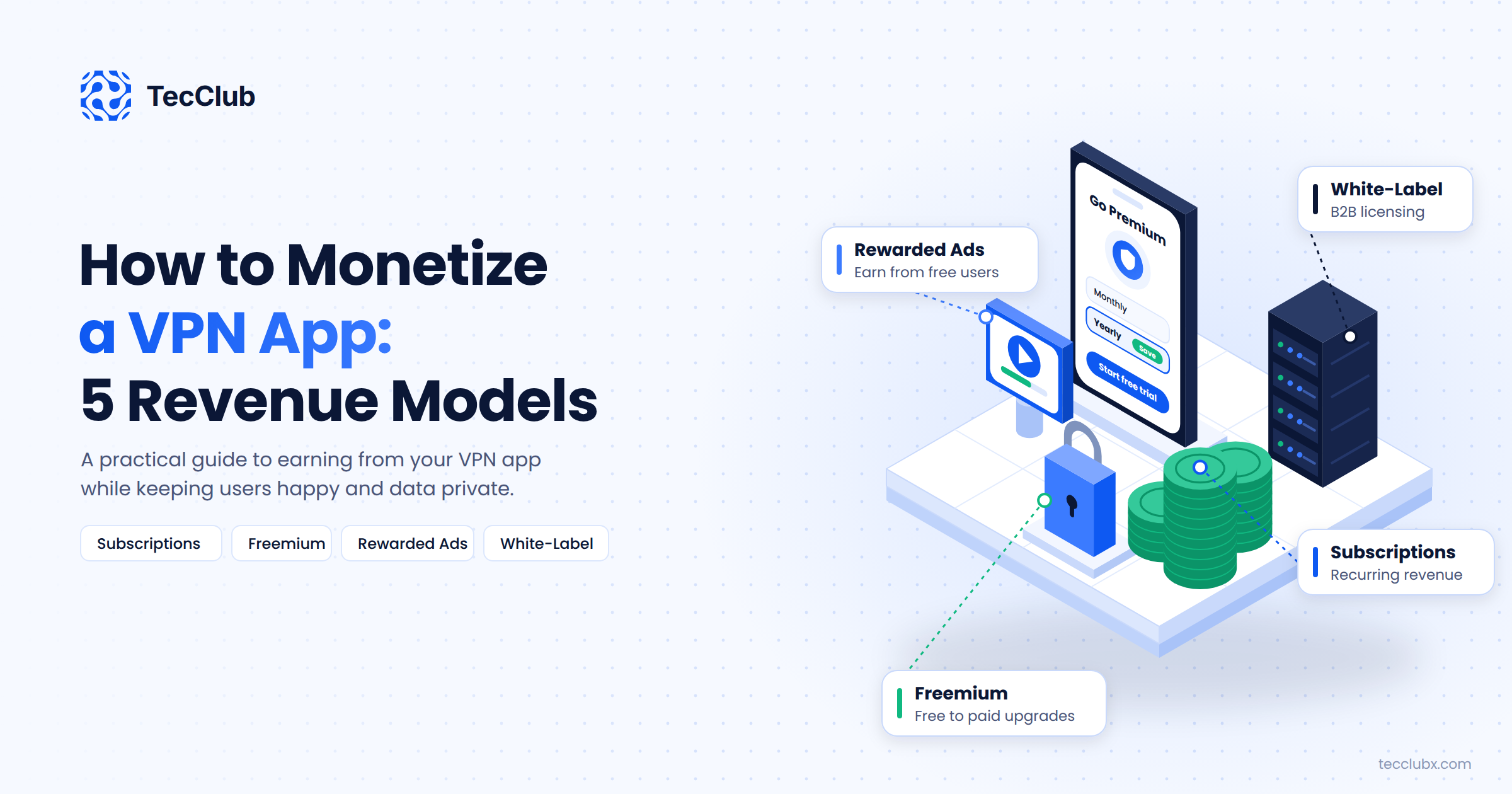
2. Revenue Model 1: Subscription-Based Sales
Subscription pricing is one of the most straightforward white-label VPN revenue models. The provider sells access on a monthly or annual basis, often with different feature tiers or user limits. This approach fits businesses that want predictable VPN subscription revenue and a clear path to retention.
It is also one of the easiest models for buyers to understand. Customers pay for secure access over time, and the provider gets a recurring relationship rather than a one-time transaction. That recurring structure is especially valuable in cybersecurity, where ongoing access and service continuity are part of the product value.
Monthly and annual plans
Monthly plans can lower the barrier to entry for small businesses or trial customers, while annual plans can support stronger commitment and simpler renewals. In a white-label environment, the partner can choose how to position each option. Some may emphasize flexibility; others may push annual contracts to reduce churn and strengthen cash flow.
The same platform can support multiple tiers. For example, a provider may offer a basic plan for small teams, a mid-tier plan for managed VPN services, and an enterprise VPN subscriptions package with more advanced controls. This allows the white label VPN business model to address different budgets and use cases without changing the core service.
Predictable recurring revenue and retention
Subscription-based sales are attractive because they create recurring revenue cybersecurity businesses can plan around. Instead of relying only on new sales, the provider builds value through renewals, upgrades, and customer retention. That makes the model especially suitable for MSPs and security vendors who already work with long-term client relationships.
Retention depends on perceived value. If the VPN is positioned as part of a broader security stack or as a practical business tool, customers are more likely to renew. Clear onboarding, responsive support, and useful packaging all help keep subscription VPN accounts active over time.
| Subscription Approach | Best For | Revenue Effect |
|---|---|---|
| Monthly billing | Small businesses, trial users | Lower entry barrier and flexible adoption |
| Annual billing | Stable B2B customers | More predictable cash flow and retention |
| Tiered plans | Different team sizes and needs | Supports upsells and segmentation |
3. Revenue Model 2: Reseller and Channel Partnerships
A VPN reseller program lets partners sell the service to their own audience while earning margin on each account. This is a natural fit for companies that already have customer relationships but do not want to build infrastructure themselves. It also aligns well with channel partner revenue strategies and the broader white-label VPN business model.
In this model, the vendor supplies the platform, and the reseller handles positioning, sales, and sometimes first-line support. That division of labor can make the offer easier to launch and more efficient to scale, particularly for MSPs, VARs, and other service-led businesses.
Margin-based resale
Margin-based resale works when the partner buys access at one price and resells it at another. The spread between those prices becomes the partner’s earnings. This structure can be attractive when the provider offers competitive wholesale pricing and the partner can package the VPN with consulting, deployment, or security reviews.
For cybersecurity resellers, the appeal is not just the product margin itself. It is also the opportunity to attach the VPN to broader security needs. That is where cybersecurity reseller margins can improve, especially when the VPN is sold as part of an integrated client solution.
VAR and MSP packaging
VAR and MSP packaging often works best when the VPN is not sold alone. Instead, it becomes one component in a larger managed service bundle. That could include onboarding, policy configuration, user training, and ongoing management. The result is a more complete offer and a stronger relationship with the client.
This approach can also support a zero trust network access reseller strategy when the VPN is positioned as part of a larger secure access framework. The reseller may not need to explain the technical details in depth; instead, the value is framed around secure access, administration, and convenience.
4. Revenue Model 3: Affiliate and Referral Commissions
A VPN affiliate program is best suited to marketers, publishers, and creators who can drive traffic but may not want to manage customer support or service delivery. Instead of earning margin from direct resale, the affiliate earns a commission for referred customers who sign up through tracked links or partner codes.
This model is often easier to start because it does not require the same level of operational involvement as a reseller program. For providers, it can expand reach into new audiences without adding a full sales team. For affiliates, it offers a straightforward way to participate in cybersecurity SaaS revenue.
Lifetime commission structures
Some programs use lifetime commission structures, where the affiliate earns on the customer relationship over time. When that is available, the model becomes more attractive because it reflects the recurring nature of the subscription. Even when commissions are limited, the opportunity to earn on initial and renewal activity can make the model meaningful.
The key is alignment. If the provider sells a subscription-based VPN and the affiliate is rewarded for driving recurring sign-ups, both sides benefit from long-term customer value rather than a one-time click.
Traffic-to-revenue conversion
Affiliate and referral models depend on traffic-to-revenue conversion. The audience has to discover the offer, trust the recommendation, and take action. That makes clear messaging and relevant audience targeting essential. A partner site focused on privacy, secure work, or IT tools may be a good fit if the VPN product is positioned correctly.
For providers, the affiliate channel can be a cost-effective route into a broader market. For affiliates, the main challenge is matching content, audience intent, and offer type. When those pieces align, the VPN affiliate program can become a steady source of referral-based income.
5. Revenue Model 4: Bundled Managed Security Services
Bundling the VPN with other services is one of the most effective ways to increase value and move beyond a standalone subscription. In a managed security context, the VPN may be combined with ZTNA, firewall capabilities, endpoint tools, or related controls. This approach supports managed VPN services and can raise the overall contract value.
Bundling works because buyers often want outcomes, not isolated tools. When a provider packages secure remote access as part of a broader service set, the offer feels more complete and more relevant to business needs.
Combining VPN with ZTNA, firewall, or endpoint tools
Combining the VPN with ZTNA or other security tools allows the provider to position secure access in a more modern and flexible way. A white-label VPN platform can serve as the base layer while additional services improve the overall package. This is especially useful for service providers who already deliver network security or endpoint management.
A bundle might include remote access, policy management, and related support in one offer. The exact mix can vary, but the common thread is that the VPN becomes part of a broader white-label security platform rather than a standalone product.
Increasing average contract value
Bundled offers often increase average contract value because more needs are covered in one agreement. That can improve revenue without requiring entirely new customer acquisition. For MSPs and VARs, bundling also makes the offer easier to justify because the customer sees broader operational value.
In practical terms, a client may begin with a VPN need and later expand into a larger managed relationship. That path supports renewals, upsells, and deeper account coverage, all of which strengthen channel partner revenue over time.
| Bundle Type | Primary Benefit | Commercial Impact |
|---|---|---|
| VPN only | Simple, focused offer | Easier to launch but narrower value |
| VPN plus ZTNA | Broader secure access story | Supports higher-value contracts |
| VPN plus managed tools | Ongoing service relationship | Improves retention and expansion potential |
6. Revenue Model 5: Usage-Based and Tiered Licensing
Usage-based and tiered licensing gives providers another way to align pricing with customer scale. Instead of charging a flat price for everyone, the provider can base fees on connections, users, or plan level. This makes the white label VPN business model more flexible for customers with different usage patterns.
It can also help providers serve both small clients and enterprise buyers from the same platform. The key is to keep the licensing model clear enough that customers understand what they are buying and how their cost changes as they grow.
Connection-based pricing
Connection-based pricing can work well when customers need a defined amount of access. The provider may charge by user, by connection, or by another usage measure that reflects the value delivered. That structure is useful when the goal is to match cost with actual deployment.
This model also helps partners present a more customized offer. A smaller team may start with a lower connection tier, while a larger customer can move to a higher band without changing vendors. That flexibility is one reason usage-based licensing can fit a SaaS VPN platform well.
Scaling for enterprise customers
Enterprise customers often need a model that supports larger deployments and procurement requirements. Tiered licensing can make that possible by organizing features, access levels, or support terms into clearer packages. For providers, this can improve expansion opportunities as customer needs grow.
Enterprise VPN subscriptions may also benefit from a licensing structure that mirrors the way the client buys software or managed services elsewhere. If the pricing logic is predictable and aligned with operational scale, it becomes easier to close larger deals and maintain long-term relationships.
7. How Providers Maximize Profitability
White-label VPN platforms are attractive not only because they support multiple revenue models, but also because they can improve profitability through operational efficiency. A provider that avoids building everything from scratch can focus on sales, positioning, and customer expansion while the platform handles much of the service layer.
This matters in recurring revenue cybersecurity businesses, where margins are shaped by support costs, retention, and the ability to sell more to existing customers.
Lower support and infrastructure overhead
Lower support and infrastructure overhead can make a major difference in the economics of the business. A platform-based approach may reduce the need for a large internal technical team dedicated to basic service delivery. That can leave more room for marketing, customer success, and partner enablement.
For resellers and MSPs, the same logic applies. If the underlying platform is stable and easy to manage, the business can spend less time on operational issues and more time on selling and account growth.
Upsells, renewals, and add-ons
Profitability often improves when providers focus on renewals and add-ons instead of only new logos. A customer who starts with a simple subscription VPN may later need a higher tier, extra users, or a bundled managed service. Each of those steps can increase lifetime value.
Upsells work best when the customer already trusts the provider. That is why white-label models can be powerful: the partner brand stays front and center, while the platform supports expansion behind the scenes. Over time, this can strengthen recurring revenue, especially when renewal motions are built into the service experience.
8. Choosing the Right Revenue Model
There is no single best approach to white-label VPN monetization. The right model depends on the audience, the sales motion, and the provider’s existing strengths. A business that already works closely with clients may prefer managed VPN services or reseller packaging, while a content-driven marketer may get better results from a VPN affiliate program.
The most effective strategy often starts with one model and expands over time. For example, a partner might begin with subscription sales, then add bundling, or begin with referrals and later move into direct resale. The white-label structure makes that kind of evolution possible without changing the core service.
Match model to audience and sales motion
Audience fit is critical. MSPs and VARs may do well with channel partner revenue and bundled services because they already operate in relationship-driven environments. Affiliates may prefer commission-based structures because they focus on content and traffic. Security vendors may lean toward enterprise VPN subscriptions or licensing models that support larger contracts.
Sales motion matters too. If the buyer wants a quick purchase, a simple subscription model may work best. If the buyer expects consultation and implementation, a reseller or managed service model may be more appropriate. Matching the model to the buying process helps the offer feel natural instead of forced.
Key metrics to track
To evaluate performance, providers should focus on the metrics that matter most for their chosen model. These may include renewal rate, average contract value, conversion rate, partner performance, and expansion revenue. The specific numbers will vary, but the broader goal is the same: build a repeatable path to profitable growth.
A practical way to assess fit is to ask three questions: Can the model scale? Does it support recurring revenue? Does it match the way the customer wants to buy? If the answer is yes, the model is likely worth pursuing.
| Model | Best Fit | Primary Value |
|---|---|---|
| Subscription | Direct sellers, SMBs, B2B | Recurring revenue and predictable renewals |
| Reseller / Channel | MSPs, VARs, security partners | Margin-based sales and account ownership |
| Affiliate | Content creators, publishers | Commission income from referrals |
| Bundled services | Managed service providers | Higher contract value and retention |
| Tiered licensing | Enterprise and growth-stage buyers | Flexible pricing aligned to scale |
Conclusion
White-label VPN platforms are more than a convenient way to launch a branded secure access service. They are also a flexible foundation for multiple revenue models, including subscriptions, reseller programs, affiliate commissions, bundled managed services, and tiered licensing. That flexibility is what makes them so appealing to MSPs, VARs, affiliates, SaaS founders, and security vendors looking for recurring revenue cybersecurity opportunities.
The best model depends on how you sell, who you serve, and how much operational involvement you want to take on. If you want predictable cash flow, subscription VPN revenue may be the right path. If you already have customer relationships, a VPN reseller program or managed VPN services bundle may fit better. If your strength is content and traffic, an affiliate approach may be the simplest entry point. And if you serve larger organizations, enterprise VPN subscriptions and usage-based licensing can support growth at scale.
In every case, the core advantage is the same: a white-label setup lets you focus on branding, relationships, and revenue while the platform supports the technical delivery behind the scenes. That combination can turn secure access into a practical, scalable business opportunity.