Understanding Transport Layers in V2Ray-Based Systems
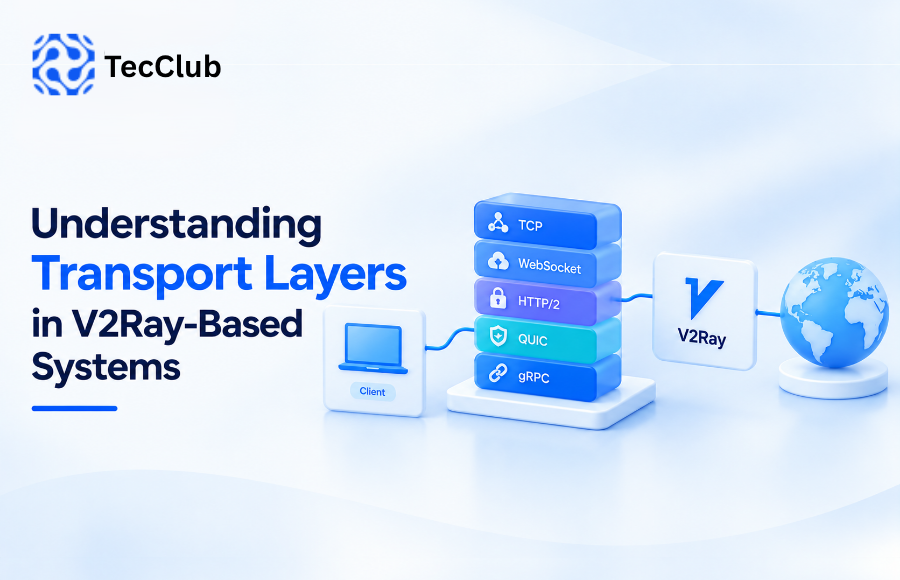
V2Ray-based systems are widely used when applications need flexible traffic routing, multiple protocol options, and different ways to carry network traffic. One of the most important parts of a V2Ray-based architecture is the transport layer.
The transport layer determines how data is carried between the client and server. While protocols such as VLESS, VMess, and Trojan are responsible for handling communication and authentication, the transport layer defines how that communication is delivered over a network.
Understanding this distinction is important when developing modern VPN applications, proxy platforms, and white-label networking products.
1. What Is a Transport Layer?
In simple terms, a transport layer is the mechanism used to carry application traffic between two endpoints.
A V2Ray-based connection can be thought of as several components working together:
Application → Protocol → Transport → Network → Server
For example, a VLESS connection may use a particular transport method to move its traffic between the client and server.
The protocol and transport are therefore not necessarily the same thing.
-
Protocol: Defines how the communication is structured and authenticated.
-
Transport: Defines how the data is carried.
-
Routing: Determines where the traffic should go.
-
Network: Provides the underlying IP connectivity.
This separation gives V2Ray-based systems considerable flexibility.
2. Why Transport Matters
Choosing a transport affects several characteristics of a connection, including:
-
Connection compatibility
-
Latency
-
Reliability
-
Traffic behavior
-
Network requirements
-
Server configuration
-
Deployment complexity
-
Performance under different network conditions
There is no universal transport that is ideal for every environment.
A transport that works well on one network may behave differently on another because of firewalls, proxies, NAT behavior, network policies, or infrastructure configuration.
3. TCP Transport
TCP is one of the fundamental transport options used by networking systems.
In a V2Ray-based deployment, TCP can provide a straightforward and reliable connection between the client and server.
Its major characteristics include:
-
Reliable packet delivery
-
Ordered data transmission
-
Broad network compatibility
-
Established infrastructure support
-
Straightforward server deployment
TCP is often useful when simplicity and compatibility are more important than specialized transport behavior.
However, TCP itself does not automatically provide privacy or encryption. Those responsibilities come from the surrounding protocol and security configuration.
4. WebSocket Transport
WebSocket is another transport option commonly associated with V2Ray-based deployments.
It allows communication through a WebSocket connection, which can be particularly useful when a deployment is designed around web infrastructure.
A typical architecture can look like:
V2Ray Client → WebSocket → Web Server/Proxy → V2Ray Server
This can make WebSocket useful in environments where existing web infrastructure is already part of the deployment.
WebSocket can also work alongside reverse proxies and other HTTP-oriented infrastructure, depending on the architecture.
The important point is that WebSocket is the transport mechanism, while the underlying V2Ray protocol remains responsible for its own communication logic.
5. HTTP/2-Based Transport
HTTP/2 introduced features such as multiplexing, stream management, and more efficient use of a connection.
V2Ray-based systems can use HTTP/2-related transport configurations to carry traffic through HTTP/2 infrastructure.
Potential benefits include:
-
Multiplexed streams
-
Efficient connection management
-
Compatibility with HTTP/2 infrastructure
-
Reduced connection overhead in suitable deployments
However, HTTP/2-based configurations can require more careful infrastructure planning.
The client, server, proxy layer, TLS configuration, and routing environment need to work together correctly.
6. gRPC Transport
gRPC-based transport has become another important option in modern proxy and networking architectures.
Instead of creating a completely custom transport mechanism, gRPC uses HTTP/2-based communication patterns.
A simplified architecture can look like:
Client → gRPC → HTTP/2 → Server
This approach can be useful when an application already operates within infrastructure that supports HTTP/2 and gRPC.
For VPN and networking developers, gRPC may provide an additional way to structure communication while keeping the transport separate from the application-level protocol.
7. QUIC-Based Transport
QUIC is a modern transport protocol built on UDP.
Unlike traditional TCP connections, QUIC integrates encrypted transport mechanisms and supports multiple streams within a connection.
Its architecture can provide advantages such as:
-
Faster connection establishment in suitable scenarios
-
Stream-level handling
-
Better behavior when individual streams experience packet loss
-
Modern congestion-control mechanisms
-
Encrypted transport
QUIC can therefore be useful for applications where modern transport behavior is important.
However, UDP-based traffic can behave differently from TCP on restrictive networks, so deployment conditions still matter.
8. HTTP/3 and QUIC
HTTP/3 is built on QUIC rather than TCP.
This creates an important distinction when discussing modern V2Ray-based systems.
A simplified relationship is:
HTTP/3 → QUIC → UDP/IP
Compared with the traditional:
HTTP/2 → TCP → IP
HTTP/3 can provide modern connection management and multiplexing characteristics while operating over QUIC.
For developers, this means that HTTP/3-related deployments need to consider UDP support throughout the infrastructure.
9. TLS and Transport Are Different
One of the most common misunderstandings is treating TLS as a transport layer.
TLS is primarily a security protocol that provides encryption and authentication for a communication channel.
Transport describes how data is carried, while TLS helps protect that communication.
For example:
VLESS + TCP + TLS
can be understood as:
-
VLESS → communication protocol
-
TCP → transport
-
TLS → security layer
Similarly, a deployment may combine a protocol with another transport and security configuration.
Keeping these layers separate makes system architecture easier to understand and troubleshoot.
10. Transport Selection Depends on the Environment
Transport selection should not be based simply on which option appears most advanced.
Developers need to consider the environment where the application will operate.
Important questions include:
-
Does the network support UDP?
-
Is TCP more widely compatible?
-
Is HTTP infrastructure already available?
-
Is a reverse proxy being used?
-
Does the server support the required transport?
-
Is TLS required?
-
What level of latency is acceptable?
-
How many concurrent connections are expected?
-
Are mobile networks involved?
-
How frequently will users switch networks?
The correct configuration depends on the complete infrastructure rather than one component.
11. Transport Layers and Mobile VPN Apps
Transport selection becomes particularly important when developing VPN applications for Android and iOS.
Mobile users frequently move between:
-
Wi-Fi
-
Cellular networks
-
Public hotspots
-
Different network providers
These changes can interrupt existing connections.
A well-designed VPN application therefore needs to combine transport configuration with reliable connection-state management.
For example, when a network changes, the application may need to:
-
Detect the network change.
-
Check whether the current connection remains usable.
-
Re-establish the tunnel if required.
-
Reapply the appropriate configuration.
-
Verify connectivity.
-
Update the connection state shown to the user.
This is especially important for VPN products where users expect the connection to recover without manually restarting the application.
12. Transport and Performance
Transport configuration can influence application performance, but performance should be measured rather than assumed.
Important metrics include:
Latency
The time required for data to travel between endpoints.
Throughput
The amount of data that can be transferred over a period.
Connection establishment time
How long the system takes to establish a usable connection.
Packet loss
Lost packets can affect application responsiveness and throughput.
CPU usage
Some transport configurations may create different processing requirements.
Connection stability
A transport that performs well in a controlled test may behave differently on unstable mobile or congested networks.
This is why VPN developers should test transports under realistic network conditions.
13. Transport and Server Infrastructure
Transport configuration also affects server-side architecture.
A production VPN platform may contain:
-
V2Ray or Xray-based services
-
Reverse proxies
-
TLS termination
-
Load balancers
-
DNS infrastructure
-
Monitoring systems
-
User authentication services
-
Configuration APIs
-
Server health monitoring
The transport cannot be considered independently from these components.
For example, introducing a reverse proxy may change how the client reaches the underlying networking service. Similarly, adding multiple servers requires consistent configuration management across the infrastructure.
14. Multiple Transports in One Platform
A modern VPN platform does not necessarily have to rely on a single transport configuration.
Different server groups can be configured for different requirements.
For example:
| Environment | Possible Transport |
|---|---|
| General TCP-compatible networks | TCP |
| Web-oriented infrastructure | WebSocket |
| HTTP/2 infrastructure | HTTP/2 |
| gRPC-based deployment | gRPC |
| Modern UDP environment | QUIC |
| HTTP/3 deployment | HTTP/3 |
These are examples rather than universal recommendations.
The objective is to build a system where transport choices can be managed according to actual infrastructure and network requirements.
15. Transport Configuration in a VPN Backend
For a commercial VPN application, transport settings should ideally not be hard-coded throughout the mobile application.
Instead, a backend can manage configuration information such as:
-
Server address
-
Port
-
Protocol
-
Transport
-
Security settings
-
Server region
-
Server status
-
Capacity
-
Configuration version
The application can then retrieve the appropriate configuration through an API.
This makes infrastructure management easier when servers or configurations change.
16. Monitoring Transport Performance
A production VPN platform should monitor how its infrastructure behaves.
Useful metrics can include:
-
Active connections
-
Connection success rate
-
Connection failures
-
Average latency
-
Server load
-
Bandwidth consumption
-
Error rates
-
Reconnection frequency
-
Traffic volume
-
Server availability
Monitoring can help developers identify whether a problem is related to the application, server, transport configuration, network, or another infrastructure component.
17. Transport Layers and White-Label VPN Platforms
Transport flexibility can be especially valuable for a white-label VPN business.
A white-label platform may need to support different server locations and networking configurations while presenting a simple experience to end users.
From the customer's perspective, the process can remain simple:
Choose Server → Tap Connect → VPN Connects
Behind the scenes, the platform can determine:
-
Which protocol to use
-
Which transport to use
-
Which server is available
-
Which configuration is appropriate
-
Whether a fallback configuration is required
This separation allows the user interface to remain simple while the infrastructure handles the technical complexity.
18. Common Transport-Layer Mistakes
Several mistakes can make V2Ray-based systems harder to maintain.
Treating Protocol and Transport as the Same Thing
VLESS, VMess, and similar protocols should not automatically be treated as transport mechanisms.
Choosing Transport Without Testing
A configuration should be tested against the networks where the application will actually operate.
Hard-Coding Configurations
Hard-coded server and transport settings make infrastructure changes more difficult.
Ignoring Mobile Networks
A configuration that works perfectly on Wi-Fi may behave differently on cellular networks.
Poor Monitoring
Without connection and server metrics, diagnosing transport-related failures becomes difficult.
Overcomplicating the Architecture
Adding multiple layers without a clear operational reason can increase maintenance and troubleshooting complexity.
19. A Practical V2Ray Transport Architecture
A scalable application might use an architecture similar to:
Mobile App
↓
API / Authentication
↓
Server & Configuration Selection
↓
Protocol Configuration
↓
Transport Layer
↓
Secure Network Connection
↓
VPN / Proxy Server
↓
Internet
The backend can dynamically provide configuration while the client focuses on establishing and maintaining the connection.
This architecture also makes it easier to add new server locations, update configurations, and manage infrastructure centrally.
How TecClub Technology Approaches V2Ray-Based VPN Development
At TecClub Technology, we develop custom VPN applications and networking platforms with attention to both the user-facing application and the infrastructure behind it.
Our VPN development capabilities can include:
-
Android VPN applications
-
iOS VPN applications
-
Windows and macOS VPN applications
-
V2Ray and Xray-based integrations
-
VLESS and VMess implementations
-
Sing-box integrations
-
WireGuard and OpenVPN support
-
Custom VPN backends
-
Laravel-based administration systems
-
Server management dashboards
-
Subscription management
-
Server monitoring
-
Smart server selection
-
Multi-protocol configurations
-
API-driven configuration delivery
-
White-label VPN platforms
The goal is not simply to connect an application to a server. A production VPN platform requires coordinated development across the mobile or desktop client, backend, server infrastructure, configuration management, monitoring, and user experience.
Conclusion
Transport layers are an important part of V2Ray-based system architecture because they determine how communication is carried between endpoints.
TCP, WebSocket, HTTP/2, gRPC, QUIC, and HTTP/3 can serve different architectural requirements. Their suitability depends on the surrounding infrastructure, network environment, performance requirements, and deployment strategy.
For VPN developers, understanding the difference between protocol, transport, security, routing, and infrastructure makes it easier to design systems that are maintainable and adaptable.
As VPN platforms become more sophisticated, transport flexibility can become an important part of building reliable multi-protocol applications and scalable white-label VPN solutions.