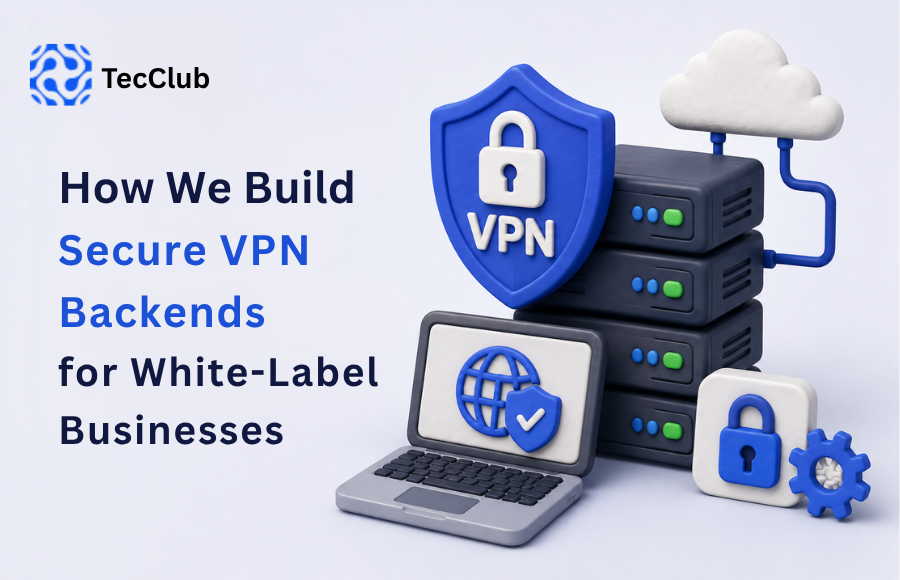
How We Build Secure VPN Backends for White-Label Businesses
1. What a White-Label VPN Backend Actually Does
A white-label VPN backend is the part of the platform that does the real work behind the brand. The customer sees the logo, the app name, and the business identity, but the backend handles the network, access decisions, encryption, logging, and operational controls that make the service function. For SaaS founders, MSPs, telecom teams, cybersecurity buyers, and product managers, understanding this layer is essential because the strength of the offering depends less on branding and more on VPN infrastructure security.
At a practical level, the backend usually includes core services for authentication, tunnel management, policy enforcement, tenant configuration, logging, and administrative controls. It also connects to the servers or gateways that users actually reach when they start a secure remote access session. In other words, the white-label layer changes how the product is presented, while the backend determines how it behaves and how safely it operates.
Core backend components
A secure VPN backend architecture generally needs several building blocks working together:
- Identity and access services for VPN authentication and user policy enforcement.
- Encryption and tunnel management for IPsec VPN security or TLS VPN security.
- Administrative controls for tenant and brand configuration.
- Logging and monitoring for operational visibility and auditability.
- Infrastructure controls such as hardening, segmentation, and patch management.
How branding differs from infrastructure
Branding can change the customer experience, but it does not reduce the need for strong technical controls. A reseller VPN solution or B2B VPN platform still has to defend against weak credentials, misconfigurations, poor tenant separation, and exposed management interfaces. That is why the most important questions are not only about appearance, but about how the backend is built, operated, and secured.
Where security responsibilities sit
In a white-label model, responsibilities are often shared. The provider may manage the underlying infrastructure, while the reseller or business customer configures users, policies, and branding. Good security depends on clear boundaries. If those boundaries are vague, gaps appear in access control, logging, or incident response. A strong partner makes the split explicit and supports safe defaults.
2. Security Principles We Use in the Architecture
Every secure VPN backend should start with a design philosophy, not just a feature list. We build around zero-trust assumptions, strict access rules, and separation of duties so that no user, device, tenant, or admin is trusted automatically. These principles matter because VPN platforms sit at the edge of private access, where a single weakness can expose sensitive traffic or administrative controls.
Zero-trust access by default
Zero trust network access means authentication and authorization do not stop at the login screen. Users must continually prove who they are and whether they should be allowed into a specific resource. This approach is especially useful for secure remote access because the backend can evaluate identity, policy, and context before issuing access.
Zero trust is not just a slogan in VPN infrastructure security; it is a design choice that limits what any one session can reach.
Least-privilege design
Least privilege keeps users, services, and administrative roles narrowly scoped to what they actually need. In a secure VPN backend, that means users only get the tunnels, routes, and permissions required for their job. Administrative accounts should also be separated so no single role can make unrestricted changes across tenants or services.
Separation of tenants and roles
A multi-tenant VPN platform must keep customers isolated from one another at every layer. That includes policies, logs, configuration data, and operational controls. Role separation also matters internally, because support teams, operations teams, and customer admins should not all have the same level of access. Strong separation lowers the risk of accidental exposure and helps contain mistakes.
3. Authentication, Authorization, and Identity
Identity is the front door of the entire system. If authentication is weak, every other control becomes harder to trust. That is why secure VPN backend design treats identity as a first-class security layer, not an add-on.
SSO and MFA integration
When possible, the backend should integrate with single sign-on and multi-factor authentication. This supports stronger VPN authentication and makes it easier for businesses to align access with their existing identity systems. It also reduces password sprawl, which is a common source of account compromise.
Device posture and user policies
Access should not depend only on a username and password. The backend can also apply policy checks based on user role, tenant, or device status. This makes it easier to control who can connect, from where, and under what conditions. For buyers evaluating secure remote access, this is an important signal that the platform is built for real enterprise use rather than basic connectivity alone.
Session management and token security
Session controls should be designed carefully so that a stolen token or abandoned session does not remain valid for too long. Token handling, session timeouts, and revocation capabilities all matter in a secure VPN backend. Strong authorization must also persist after login, so permissions can be adjusted without rebuilding the whole access model.
4. Encryption and Tunnel Protection
Encryption is one of the clearest signs that a VPN platform takes security seriously, but strong encryption has to be paired with correct implementation. A secure VPN backend should support proven tunnel technologies and manage cryptographic material carefully.
IPsec vs TLS-based VPN layers
Both IPsec VPN security and TLS VPN security are relevant depending on the product and use case. The important point is not to overstate one method as universally superior, but to ensure that whichever approach is used is implemented consistently and correctly. A B2B VPN platform may need one or both layers depending on how users connect, what devices they use, and how policies are enforced.
| Area | IPsec | TLS-based VPN |
|---|---|---|
| Primary focus | Network-layer protection | Transport-layer protection |
| Typical use | Secure tunnels between endpoints | Secure client or application access |
| Operational concern | Policy and key handling | Certificate and session handling |
Key exchange and certificate handling
Regardless of the tunnel method, key exchange and certificate management must be tightly controlled. Certificates should be issued, stored, and rotated using secure processes, and access to private keys should be restricted. Weak handling here can undermine otherwise strong VPN encryption standards.
Rotating credentials and secrets
Secrets and credentials should not be treated as permanent. Rotating keys, certificates, and administrative credentials reduces exposure over time and limits the damage from compromise. It also improves resilience in cases where a credential is unintentionally exposed in a deployment workflow or operational system.
5. Backend Infrastructure Hardening
The VPN service is only as strong as the systems running it. That is why VPN server hardening and infrastructure controls are foundational. A secure backend reduces unnecessary exposure before traffic even reaches the tunnel layer.
Server hardening and patch management
Servers should be configured with minimal services, secure defaults, and timely patching. Hardening reduces the attack surface, while patch management helps close known vulnerabilities before they become incidents. This applies to gateway systems, management hosts, and internal services supporting the platform.
Network segmentation and firewalling
Segmentation limits how far an attacker can move if one component is affected. Firewalls should restrict management interfaces, backend services, and tenant traffic to only what is required. For VPN infrastructure security, this kind of compartmentalization is essential because VPN systems often sit at a sensitive intersection of identity, connectivity, and internal access.
Container and cloud security controls
Where containerized or cloud-based components are used, the same discipline still applies. Images, runtime permissions, network rules, and orchestration settings should be reviewed carefully. The objective is consistent: reduce privilege, reduce exposure, and make sure each component can only reach what it must.
6. Logging, Monitoring, and Auditability
Security without visibility is incomplete. A secure VPN backend needs logging and monitoring that support troubleshooting, incident response, and compliance expectations. The goal is to collect enough information to understand behavior without over-collecting sensitive data.
Security logs and retention policies
VPN logging best practices start with defining what is logged, why it is logged, and how long it is retained. Logs should support access review, operational analysis, and security investigation. Retention policies should match the business and compliance requirements of the service, while avoiding unnecessary data accumulation.
Anomaly detection and alerting
Monitoring should help teams notice unusual access patterns, repeated failed logins, unexpected changes, or spikes in usage. Alerting is especially useful when the platform supports multiple tenants because issues in one customer environment should not be mistaken for a platform-wide failure. Quick detection shortens response time and reduces uncertainty.
Compliance-friendly audit trails
Audit trails should be understandable, tamper-resistant where possible, and aligned with the permissions model. That means administrative actions, policy changes, and key access events should be traceable without exposing more sensitive content than necessary. For many buyers, auditability is one of the clearest indicators that a reseller VPN solution is designed for business use.
7. Multi-Tenant Design for White-Label Providers
White-label VPN businesses often need to serve many customers from one platform. That makes multi-tenant design one of the most important parts of the architecture. The challenge is to deliver flexibility and branding without creating data leakage or policy confusion.
Tenant isolation strategies
Tenant isolation should cover configuration, identity, logs, access rules, and administration. A multi-tenant VPN platform must ensure that one customer cannot see another customer’s data or operational details. This is not only a technical issue but also a trust issue, because the business model depends on clean separation.
Brand-level configuration without data leakage
White-label customization should remain in the presentation and policy layers, not bleed into shared data stores or insecure shared controls. Brand-specific settings can coexist with common infrastructure as long as the backend architecture preserves tenant boundaries. The safer the architecture, the easier it becomes to scale without creating hidden dependencies.
Scaling securely across customers
As the number of tenants grows, operational complexity grows too. Secure scaling means preserving security controls while adding customers, regions, or services. That includes consistent policy templates, controlled admin delegation, and predictable release processes so changes do not affect one tenant unexpectedly.
8. Compliance and Data Privacy Considerations
For many businesses, security and compliance are closely linked. A strong VPN backend should support data privacy expectations by limiting unnecessary collection, respecting regional needs, and making responsibilities explicit in contracts and service terms.
Data minimization and logging limits
Collect only what is needed for operations, security, and support. Excessive logging can create privacy risk and make the platform harder to manage. Minimal, purposeful logging is often a better fit for long-term VPN infrastructure security than broad collection with unclear use cases.
Regional hosting and residency
Some customers need their VPN services or data to remain in specific regions. The backend should be able to support those expectations where required. Hosting and residency considerations matter because they can affect both technical design and contractual commitments.
Contracts, SLAs, and shared responsibility
Contracts and service-level agreements should make security responsibilities clear. That includes who manages infrastructure, who handles tenant configuration, who responds to incidents, and how support access is controlled. A well-defined shared responsibility model protects both the vendor and the customer.
9. Deployment, Testing, and Ongoing Maintenance
Security is not finished when the platform launches. A secure VPN backend needs ongoing testing, release discipline, and operational readiness so that defenses stay effective over time.
Security testing before launch
Before deployment, the backend should be tested for configuration errors, access control issues, and weaknesses in the authentication or encryption flow. The purpose is to catch problems early, when they are easier to fix and less likely to affect customers.
Vulnerability management and incident response
After launch, vulnerability management keeps the platform current with emerging threats. If an incident occurs, teams need a documented response path that includes containment, investigation, recovery, and communication. This is especially important for business-facing VPN services, where downtime or exposure can affect multiple customers.
Release management and uptime planning
Release management should be planned so updates do not interrupt access unnecessarily. Uptime planning matters because VPN services often support essential business operations. Good maintenance balances stability, security updates, and service continuity.
10. Choosing the Right White-Label VPN Partner
For buyers evaluating a white-label VPN backend, the security story should be clear, specific, and operationally believable. Vendor claims matter less than architecture, controls, and the willingness to explain how the platform actually works.
Questions to ask vendors
Ask how the backend handles tenant isolation, authentication, encryption, logging, and admin access. Request details on VPN access control, patching, audit trails, and secrets management. Ask what responsibilities remain with the reseller and what the provider manages directly.
Red flags in security claims
Be cautious of vague statements that promise security without describing controls. Red flags include unclear ownership of logs, weak tenant separation, generic answers about encryption, or the absence of role-based administration. If a vendor cannot explain how they handle secure remote access at the backend level, that is a warning sign.
Build vs buy decision framework
The choice between building and buying depends on resources, expertise, and market goals. Building can offer control, but it also requires ongoing investment in VPN infrastructure security, monitoring, hardening, and support. Buying a reseller VPN solution or B2B VPN platform can accelerate launch, but only if the provider’s backend meets the required security standard. The right answer is the one that aligns security, speed, and operational reality.
Conclusion
A secure VPN backend for white-label businesses is not just a technical utility behind a branded app. It is the foundation that protects identity, tunnels, logs, tenants, and administrative control. The strongest platforms combine zero-trust principles, strong VPN authentication, careful encryption choices, hardened infrastructure, clear logging policies, and strict tenant isolation.
For buyers and operators, the lesson is simple: look beyond the surface. Branding is important, but the real value lies in the quality of the backend architecture and the discipline of the team running it. If you evaluate security at every layer, from access policies to release management, you will be far better positioned to choose a white-label VPN partner that can support growth without compromising trust.