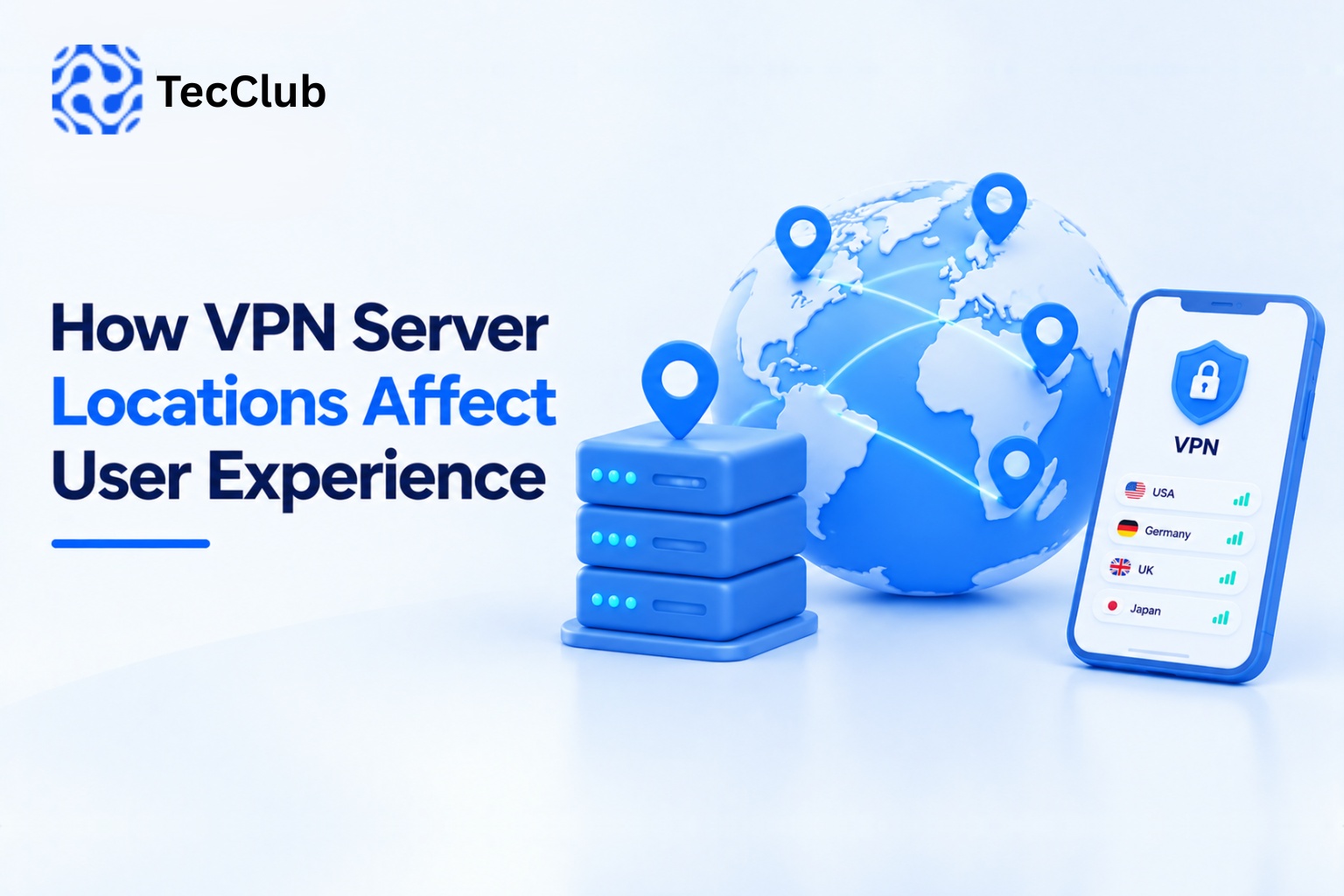
How VPN Server Locations Affect User Experience
When users open a VPN app, they often see a simple list of locations such as the United States, United Kingdom, Germany, Singapore, Japan, or the UAE.
Choosing one of these locations may look like a simple preference, but the physical and network location of a VPN server can have a noticeable effect on the overall user experience.
Server location can influence latency, connection speed, routing efficiency, stability, streaming performance, gaming responsiveness, and even how quickly an application establishes a connection.
For VPN developers and businesses, choosing server locations is therefore not simply about putting servers on a map. It requires understanding where users are located, how networks connect different regions, how much traffic each location can handle, and how the application selects an appropriate server.
1. What Does VPN Server Location Actually Mean?
A VPN server location generally refers to the geographic region or data-center location where the VPN infrastructure is hosted.
For example:
User
 ↓
VPN App
 ↓
VPN Server
 ├── United States
 ├── United Kingdom
 ├── Germany
 ├── Singapore
 └── Japan
The location displayed in a VPN app may represent the physical location of the server, a data-center region, or the advertised exit location, depending on how the provider operates its infrastructure.
For developers, the important question is not only where the server is located, but also how traffic reaches that server and where it goes afterward.
2. Why Distance Matters
One of the most important factors affected by server location is network latency.
In simple terms, latency is the time required for data to travel between endpoints and return.
A simplified path looks like:
User
  ↓
Local Network
  ↓
Internet Backbone
  ↓
VPN Server
  ↓
Destination
A server that is geographically closer to the user will often have a shorter network path.
However, geographic distance is not the only factor.
A nearby server can sometimes have worse latency than a slightly farther server if the network routes are inefficient or congested.
3. Latency and VPN Responsiveness
Latency can influence how responsive certain applications feel.
This is especially noticeable with:
-
Online gaming
-
Video calls
-
Remote desktop
-
Interactive applications
-
Voice communication
-
Real-time collaboration
For example:
User
 ↓
VPN Server A
 ↓
Low Latency
 ↓
Responsive Experience
Compared with:
User
 ↓
VPN Server B
 ↓
Higher Latency
 ↓
More Delay
The VPN server adds another network segment between the user and destination, so server selection matters.
4. Server Location and Download Speed
Server location can also affect throughput.
A user's connection might look like:
User → VPN Server → Internet Destination
The actual performance depends on several factors:
-
User's local internet connection
-
VPN server capacity
-
Data-center network
-
Routing path
-
Congestion
-
Protocol
-
Encryption overhead
-
Destination server
-
Time of day
Therefore, a VPN server being geographically close does not automatically guarantee maximum speed.
5. The Importance of Network Routing
Two servers in different locations may have very different network paths to the same user.
For example:
User
 ├── Route A → Server A
 │               ↓
 │          Efficient Path
 │
 └── Route B → Server B
                 ↓
            Congested Path
This is why VPN applications should consider network performance, not just geographic distance.
Modern infrastructure can monitor latency, availability, and other server metrics to help determine which locations are suitable for users.
6. Server Location Can Affect Connection Time
When a user taps Connect, the application may need to:
-
Authenticate the user
-
Retrieve configuration
-
Select a server
-
Resolve hostnames
-
Establish the connection
-
Configure routing
-
Confirm the tunnel is working
A simplified flow:
Tap Connect
     ↓
Authentication
     ↓
Server Selection
     ↓
Connection
     ↓
Handshake
     ↓
Tunnel Ready
A well-designed server-selection system can reduce unnecessary delays by selecting an available and suitable node.
7. Why the Nearest Server Is Not Always the Best Server
A common assumption is:
The closest VPN server must always provide the best experience.
In practice, that is not necessarily true.
Consider:
Server A
Distance: Near
Load: High
Latency: High

Server B
Distance: Moderate
Load: Low
Latency: Low
Server B could provide a better experience even though it is farther away.
This is why modern VPN applications can use multiple signals instead of selecting a server purely based on geographic distance.
8. Server Load Matters
A server's location is only one part of the equation.
Suppose two servers are available in the same region:
Server A
20% Load

Server B
90% Load
Sending more users to Server B simply because it is in the desired location may result in poorer performance.
A smarter selection system can consider:
-
CPU utilization
-
Active connections
-
Bandwidth
-
Latency
-
Server health
-
Network availability
-
Current traffic
This creates a more dynamic approach to server selection.
9. Smart Server Selection
A VPN application can evaluate several factors before recommending a server.
For example:
Available Servers
       ↓
Health Check
       ↓
Latency Test
       ↓
Load Check
       ↓
Location Preference
       ↓
Protocol Compatibility
       ↓
Recommended Server
The exact weighting can vary between products.
Some applications may prioritize user-selected locations, while others may prioritize performance.
10. Regional Server Distribution
A global VPN service may organize infrastructure into multiple regions.
For example:
                Global VPN Network
                       ↓
       ┌───────────────┼───────────────┐
       ↓               ↓               ↓
     Europe           Asia        North America
       ↓               ↓               ↓
    Germany        Singapore         USA
    France         Japan             Canada
    UK             India             Mexico
This distribution can help reduce the average distance between users and available VPN nodes.
It can also provide more choices when a particular location becomes congested.
11. Server Locations and Streaming
Users sometimes select a VPN location based on the geographic region associated with a particular online service.
For example:
User
 ↓
VPN Server in Region X
 ↓
Internet Service
The service may see the VPN server's public IP address rather than the user's original public IP.
However, the behavior of streaming platforms and other online services can vary. They may use IP reputation, account information, DNS behavior, device signals, or other mechanisms when determining access.
Therefore, a server location should not be presented as a guaranteed way to access every geographically restricted service.
12. Server Locations and Gaming
Gaming is particularly sensitive to latency.
A simplified path might be:
Player
  ↓
VPN Server
  ↓
Game Server
If the VPN server is poorly positioned, the route can become unnecessarily long:
Player
  ↓
VPN Server
  ↓
Faraway Region
  ↓
Game Server
For gaming-oriented VPN products, developers can consider latency measurements and network routing when designing server-selection systems.
13. Server Locations and Video Calls
Video calls depend on consistent network performance.
Users may notice problems when there is:
-
High latency
-
Packet loss
-
Network congestion
-
Unstable routing
-
Server overload
A VPN server closer to the relevant network path can sometimes reduce unnecessary latency.
However, video-call quality also depends heavily on the user's local connection and the video platform's infrastructure.
14. The Role of Data Centers
Two servers listed under the same city or country can still provide different performance.
Why?
Because their underlying data-center networks may differ.
Important factors can include:
-
Upstream providers
-
Peering arrangements
-
Transit routes
-
Available bandwidth
-
Hardware
-
Network redundancy
-
Data-center connectivity
So a VPN business should evaluate network quality, not just the country displayed in the application.
15. Server Location and DNS
DNS is another part of the overall experience.
A VPN application might handle DNS through:
Device
 ↓
VPN / DNS Layer
 ↓
Configured Resolver
 ↓
Internet
The relationship between DNS resolution and the VPN server can affect how requests are handled.
A well-designed VPN application should make DNS behavior consistent with its intended routing and privacy model.
16. Server Location and Network Switching
Mobile users frequently switch networks.
For example:
Wi-Fi
  ↓
Cellular
  ↓
Wi-Fi
A VPN app should be able to handle these changes appropriately.
Depending on the architecture, the application may need to:
-
Detect the network change
-
Re-establish the connection
-
Re-evaluate the server
-
Refresh network configuration
-
Restore routing
-
Update connection status
This becomes particularly important when users move between different geographic areas.
17. Multi-Region VPN Infrastructure
A larger VPN platform may use multiple server regions rather than relying on one geographic location.
For example:
                    Backend
                       ↓
                Server Selection
                       ↓
       ┌───────────────┼───────────────┐
       ↓               ↓               ↓
    Europe            Asia         Americas
       ↓               ↓               ↓
    VPN Nodes       VPN Nodes      VPN Nodes
This provides flexibility when:
-
A region becomes busy
-
A server fails
-
A network route becomes unstable
-
New users arrive
-
More geographic locations are needed
18. Location Selection vs Performance Selection
VPN applications can approach server selection in different ways.
Location-Based Selection
The user chooses:
Germany
Japan
United States
The application connects to a suitable server in that region.
Performance-Based Selection
The application evaluates available nodes and recommends one based on factors such as:
Latency
Load
Availability
Network Quality
Hybrid Selection
A more flexible model is:
User Preference
      +
Server Health
      +
Latency
      +
Load
      ↓
Recommended Server
This allows the user to retain control while still benefiting from infrastructure intelligence.
19. Multiple Servers Per Location
A professional VPN platform does not necessarily need only one server per country.
For example:
Germany
 ├── Node 01
 ├── Node 02
 ├── Node 03
 └── Node 04
If Node 01 becomes heavily loaded, the platform can potentially direct new connections toward another suitable node.
This improves infrastructure flexibility and makes it easier to expand capacity within popular locations.
20. Monitoring Location Performance
A VPN business can monitor each region independently.
For example:
Region
 ├── Latency
 ├── Active Users
 ├── Bandwidth
 ├── CPU
 ├── Memory
 ├── Connection Success
 └── Error Rate
This allows developers and infrastructure teams to identify regional bottlenecks.
For example, if one region consistently has high latency while another performs normally, the problem may require investigation of routing, providers, capacity, or server configuration.
21. Server Failover
A location can contain multiple nodes so the platform has alternatives when one becomes unavailable.
User
 ↓
Preferred Location
 ↓
Server Health Check
 ↓
Healthy?
 ├── Yes → Connect
 └── No
      ↓
Alternative Node
      ↓
Connect
The exact failover strategy depends on the application's architecture and connection protocol.
22. Choosing Server Locations for a New VPN Business
A new VPN business does not necessarily need servers in dozens of countries from day one.
A more structured approach is to evaluate:
Target Users
Where are your customers located?
Target Use Cases
Are users mainly interested in:
-
General privacy
-
Business connectivity
-
Gaming
-
Streaming
-
Travel
-
Secure public Wi-Fi
-
Regional connectivity?
Network Quality
Does the data center provide reliable connectivity and sufficient bandwidth?
Infrastructure Cost
What is the cost of running and maintaining each location?
Scalability
Can additional nodes be added when demand increases?
Legal and Operational Requirements
Are there local regulations, provider policies, or operational considerations relevant to that region?
23. Server Location Is Not the Same as User Privacy
Choosing a particular VPN location does not automatically determine every aspect of privacy.
Privacy also depends on:
-
VPN protocol
-
Encryption
-
DNS configuration
-
Application permissions
-
Logging practices
-
Backend architecture
-
Server configuration
-
Account information
-
Infrastructure providers
Therefore:
VPN Privacy
    ≠
Server Location Alone
Server geography is one component of a larger privacy and security architecture.
24. Common Server-Location Mistakes
Choosing Locations Only by Country Count
Having more countries does not automatically mean better performance.
Ignoring Network Quality
A server in a desirable location can still have poor connectivity.
Using One Node for a Popular Region
A single server can become a bottleneck as demand grows.
Ignoring Latency
Geographic distance and actual network latency are not always identical.
Not Monitoring Regional Performance
Without monitoring, infrastructure problems may remain hidden.
Automatically Selecting the Nearest Server
The closest server may not always be the healthiest or fastest option.
25. A Modern VPN Server-Selection Architecture
A scalable VPN platform can combine user preferences with real-time infrastructure information.
                 VPN App
                    ↓
             User Preference
                    ↓
                Backend
                    ↓
           Server Selection
                    ↓
      ┌─────────────┼─────────────┐
      ↓             ↓             ↓
   Location       Latency        Load
      └─────────────┼─────────────┘
                    ↓
              Health Check
                    ↓
            Suitable VPN Node
                    ↓
                Connection
This approach gives the application more information than simply asking:
Which server is closest?
Instead, it can consider several characteristics before selecting or recommending a server.
26. How TecClub Technology Approaches VPN Server Infrastructure
At TecClub Technology, VPN applications can be designed with server-location management as part of the broader backend and infrastructure architecture.
A VPN platform can include:
-
Multiple server locations
-
Regional VPN infrastructure
-
Server health monitoring
-
Load balancing
-
Smart server selection
-
User-selected locations
-
Automatic server selection
-
Server capacity monitoring
-
Protocol-specific server configurations
-
Dynamic configuration delivery
-
Android and iOS applications
-
Windows and macOS applications
-
Backend APIs
-
Admin dashboards
-
Usage monitoring
-
Subscription-based access
-
White-label VPN infrastructure
For businesses launching their own VPN brand, the server architecture can be structured around the target audience, expected traffic, geographic requirements, supported protocols, and future growth.
The objective is not simply to offer more locations, but to build an infrastructure where available locations provide a consistent and manageable user experience.
Conclusion
VPN server location has a direct relationship with how users experience a VPN, but geography is only one part of the equation.
Performance can also depend on:
-
Network routing
-
Server load
-
Bandwidth
-
Data-center connectivity
-
Latency
-
Protocol
-
DNS behavior
-
Destination location
-
Network congestion
-
Infrastructure design
A well-designed VPN application therefore treats server selection as an infrastructure problem rather than simply a list of countries.
The strongest architecture combines geographic coverage, server health, network performance, capacity, and user preferences to provide suitable connection options.
For VPN businesses, the goal should not simply be to have servers in more locations. It should be to build a server network that is reliable, scalable, intelligently managed, and aligned with the needs of its users.