When people talk about VPN performance, they usually mention speed. Or maybe security.
But what really shapes both of those things?
The protocol running underneath.
The protocol you choose affects how fast the VPN connects, how stable it stays, how secure the encryption is—and even whether it works in restricted regions.
At TecClub Technology, we don’t believe in “one-size-fits-all” solutions. The right protocol depends on who your users are, where they’re connecting from, and what they expect from the product.
Let’s break this down in simple, practical terms.
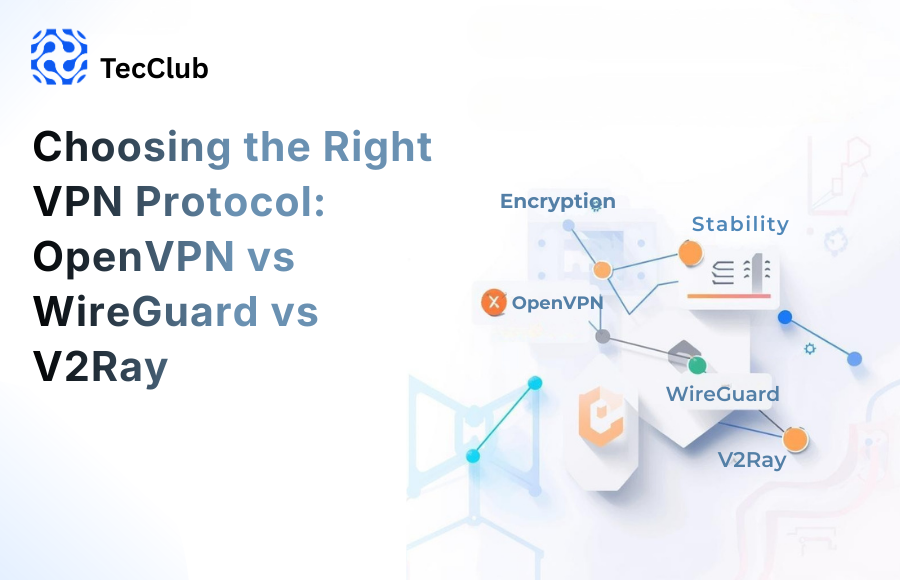
1️⃣ OpenVPN – The Reliable Veteran
OpenVPN has been around for years, and there’s a reason it’s still widely used.
It’s stable. It’s battle-tested. And it works almost everywhere.
Why People Trust It
-
Strong encryption with a long security track record
-
Extremely configurable
-
Supported on nearly every platform
-
Proven in enterprise environments
Where It Can Feel Heavy
-
Slightly slower than newer protocols in some scenarios
-
Larger codebase
-
More complex configuration
Best For
-
Enterprise VPN solutions
-
Businesses that prioritize long-term reliability
-
Traditional VPN infrastructures
Think of OpenVPN as the dependable workhorse. It may not always be the fastest—but it rarely surprises you.
2️⃣ WireGuard – Fast, Modern, Efficient
WireGuard was designed with simplicity and speed in mind.
It’s lean, clean, and incredibly fast.
Why It’s Popular
-
Excellent performance
-
Lightweight codebase
-
Faster connection times
-
Efficient on mobile devices
Where Care Is Needed
-
Less flexible configuration compared to OpenVPN
-
Requires thoughtful implementation for certain privacy models
Best For
-
Mobile VPN apps
-
Streaming and gaming
-
Modern VPN products focused on performance
If speed is your main priority, WireGuard is often the first choice.
3️⃣ V2Ray – Flexible and Built for Complex Networks
V2Ray is a bit different. It’s not just a single VPN protocol—it’s a flexible framework built for advanced routing and traffic obfuscation.
Where It Shines
-
Strong resistance to censorship
-
Advanced traffic routing
-
Multi-protocol flexibility
-
Highly customizable
Where It Requires Expertise
-
More complex to set up
-
Needs strong backend architecture
-
Not a traditional plug-and-play VPN protocol
Best For
-
Regions with heavy internet restrictions
-
Advanced routing scenarios
-
Platforms that need obfuscation capabilities
V2Ray isn’t just about encryption—it’s about adaptability.
So, Which One Is Fastest?
In simple terms:
-
Fastest raw performance: WireGuard
-
Stable and consistent: OpenVPN
-
Performance depends on configuration: V2Ray
But here’s the important part—real-world speed depends just as much on:
-
Server quality
-
Network conditions
-
Backend optimization
The protocol alone doesn’t determine everything.
What About Security?
All three can be highly secure when implemented properly.
-
OpenVPN → Mature and time-tested
-
WireGuard → Modern cryptography with a smaller attack surface
-
V2Ray → Strong encryption with flexible routing
Security isn’t about which name sounds stronger. It’s about integration, maintenance, and proper configuration.
There’s No Universal “Best” Option
The right protocol depends on your goals.
| Use Case | Recommended Approach |
|---|---|
| Enterprise stability | OpenVPN |
| High-speed mobile app | WireGuard |
| Censorship resistance | V2Ray |
| Global consumer VPN | Multi-protocol setup |
At TecClub Technology, we often recommend supporting multiple protocols instead of choosing just one.
Why Multi-Protocol Support Is Usually Smarter
Modern users connect from:
-
Home Wi-Fi
-
Mobile networks
-
Public hotspots
-
Office firewalls
-
Restricted regions
No single protocol handles every situation perfectly.
Supporting multiple options allows:
-
Higher connection success rates
-
Better performance across networks
-
Automatic adaptation to changing conditions
The app can switch intelligently—without the user even noticing.
How We Approach It at TecClub Technology
We build VPN apps with:
-
Clean protocol abstraction layers
-
Smart switching logic
-
Secure backend-controlled configuration
-
Performance tuning across regions
Whether a product needs the stability of OpenVPN, the speed of WireGuard, or the flexibility of V2Ray, we integrate them in a way that feels simple to the end user.
Final Thoughts
Choosing a VPN protocol isn’t about trends. It’s about understanding your audience, infrastructure, and real-world use cases.
-
OpenVPN offers reliability and trust.
-
WireGuard delivers speed and efficiency.
-
V2Ray provides flexibility and censorship resistance.
The strongest VPN platforms don’t just pick one—they combine them intelligently.
And when done right, users never have to think about protocols at all. They just tap Connect—and everything works.