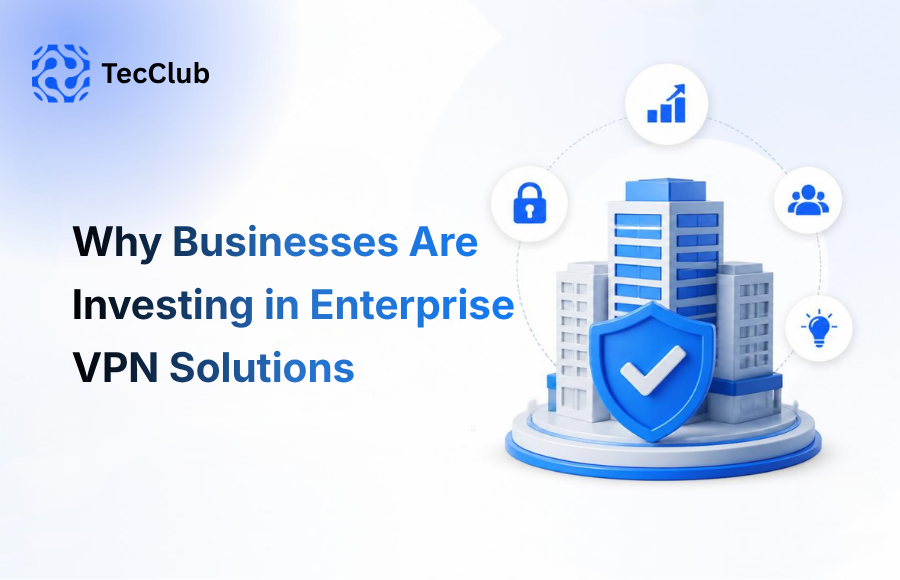
Why More Businesses Are Investing in Enterprise VPN Solutions
A few years ago, most employees worked from a single office, connected to a company network that rarely changed. Today, that picture looks very different. People work from home, from co-working spaces, from client offices, and sometimes from an airport lounge between flights. The office is no longer one place—it’s wherever the employee happens to be.
That shift has created a new challenge for businesses: how do you give people easy access to company resources without putting sensitive data at risk? That’s exactly why enterprise VPNs have become such an important investment.
At TecClub Technology, we’ve seen this change firsthand. Companies aren’t asking for VPNs because they’re trendy. They’re asking for them because secure remote access has become a basic requirement for running a modern business.
What Is an Enterprise VPN?
Think of an enterprise VPN as a secure bridge between your employees and your company’s systems. When someone connects, their internet traffic is encrypted, and they can safely access internal tools, databases, file servers, and cloud applications—even if they’re using a public Wi‑Fi network.
Unlike the consumer VPN apps people use for streaming or personal privacy, enterprise VPNs are built for organizations. They include centralized management, user authentication, access controls, and the ability to support hundreds or even thousands of employees at the same time.
In simple terms, the goal is to make remote work feel as secure as working inside the office.
Why Businesses Are Prioritizing VPNs Now
Remote work is here to stay
For many companies, remote and hybrid work started as a temporary solution and became a permanent part of how they operate. Employees still need access to internal applications, shared files, and business systems, and they need that access without exposing company data to the open internet.
A properly configured enterprise VPN gives teams a secure way to connect from almost anywhere.
Sensitive data is constantly moving
Customer records, financial information, contracts, and internal communications are traveling across networks all day long. Without encryption, that data is vulnerable to interception. Enterprise VPNs encrypt traffic between the employee’s device and the company network, making it far more difficult for attackers to eavesdrop on those communications.
Not everyone should have access to everything
One of the biggest advantages of enterprise VPNs is that they support role-based access. A marketing employee doesn’t need access to the finance database, and a contractor may only need access to a specific project portal. Combined with Multi-Factor Authentication (MFA), VPNs help ensure that the right people have access to the right resources—and nothing more.
The Cloud Changed the Game
Most businesses now use a mix of cloud services and on-premise systems. You might have files in Microsoft 365, applications running in AWS, and a database still hosted in your own office. An enterprise VPN can securely connect all of those environments, creating a protected network that feels unified to the end user.
This is especially valuable for companies that are still in the middle of their cloud migration journey.
Employees Expect Simplicity
Security tools only work if people actually use them. Older VPNs often required complicated setup instructions and constant troubleshooting. Modern enterprise VPNs are much easier to live with:
-
One-click connection
-
Automatic server selection
-
Seamless switching between Wi‑Fi and mobile networks
-
Stable connections during travel
When the experience is smooth, employees are more likely to stay connected, and IT teams spend less time answering support tickets.
Compliance Matters
Industries such as healthcare, finance, and legal services have strict requirements around protecting sensitive information. While a VPN alone doesn’t guarantee compliance, it provides several important building blocks:
-
Encrypted communications
-
Secure authentication
-
Access logging
-
Centralized user management
For many organizations, these capabilities are an essential part of their broader security and compliance strategy.
Why IT Teams Appreciate Enterprise VPNs
From an IT perspective, managing remote access for hundreds of users can become chaotic without the right tools. Enterprise VPN platforms typically include dashboards for user management, device monitoring, connection analytics, and security reporting. That centralized visibility makes it much easier to enforce policies and respond quickly if something unusual happens.
Built for Growth
A small company might start with 20 remote employees, but what happens when it grows to 200 or expands into new countries? Enterprise VPNs are designed to scale. You can add users, deploy additional servers, increase bandwidth, and support international teams without replacing the entire platform.
That scalability is one reason businesses view VPNs as a long-term infrastructure investment rather than a short-term fix.
Performance Still Matters
Security is critical, but employees also need a fast, reliable connection. Modern enterprise VPNs use technologies such as intelligent server selection, load balancing, optimized routing, and global server networks to keep performance smooth even during busy periods.
A secure connection that constantly disconnects is not a solution—so performance has become just as important as encryption.
The Business Case
When executives look at the numbers, the value becomes clear. Enterprise VPNs can help:
-
Support flexible work policies
-
Reduce travel and office-related costs
-
Simplify IT operations
-
Lower the risk of data breaches
-
Improve overall productivity
For many organizations, the investment pays for itself through a combination of operational savings and reduced security risk.
How TecClub Technology Approaches Enterprise VPNs
At TecClub Technology, we build VPN platforms around the way businesses actually operate. That includes multi-protocol support (WireGuard, OpenVPN, IKEv2/IPSec, and others), secure backend infrastructure, cross-platform applications, admin dashboards, API integrations, and role-based access management.
Some companies need a fully custom enterprise VPN. Others want a white-label solution they can deploy quickly. In both cases, the focus is the same: security, performance, and scalability.
A Few Best Practices
If you’re planning to deploy an enterprise VPN, a few things make a huge difference:
-
Enable MFA for all users
-
Use role-based access controls
-
Keep VPN software updated
-
Monitor network activity regularly
-
Integrate the VPN with your identity management system
-
Review access permissions periodically
These steps help strengthen security without making life harder for employees.
The Bottom Line
Enterprise VPNs have evolved from a niche IT tool into a core part of modern business infrastructure. They protect remote workers, secure sensitive data, simplify administration, and give organizations the flexibility to operate from anywhere.
As more companies embrace cloud services and distributed teams, investing in a secure, scalable VPN is no longer just a technical decision—it’s a business decision.
And honestly, the question is no longer “Do we need a VPN?” For most businesses, it’s “How do we deploy one that can support where we’re headed next?”