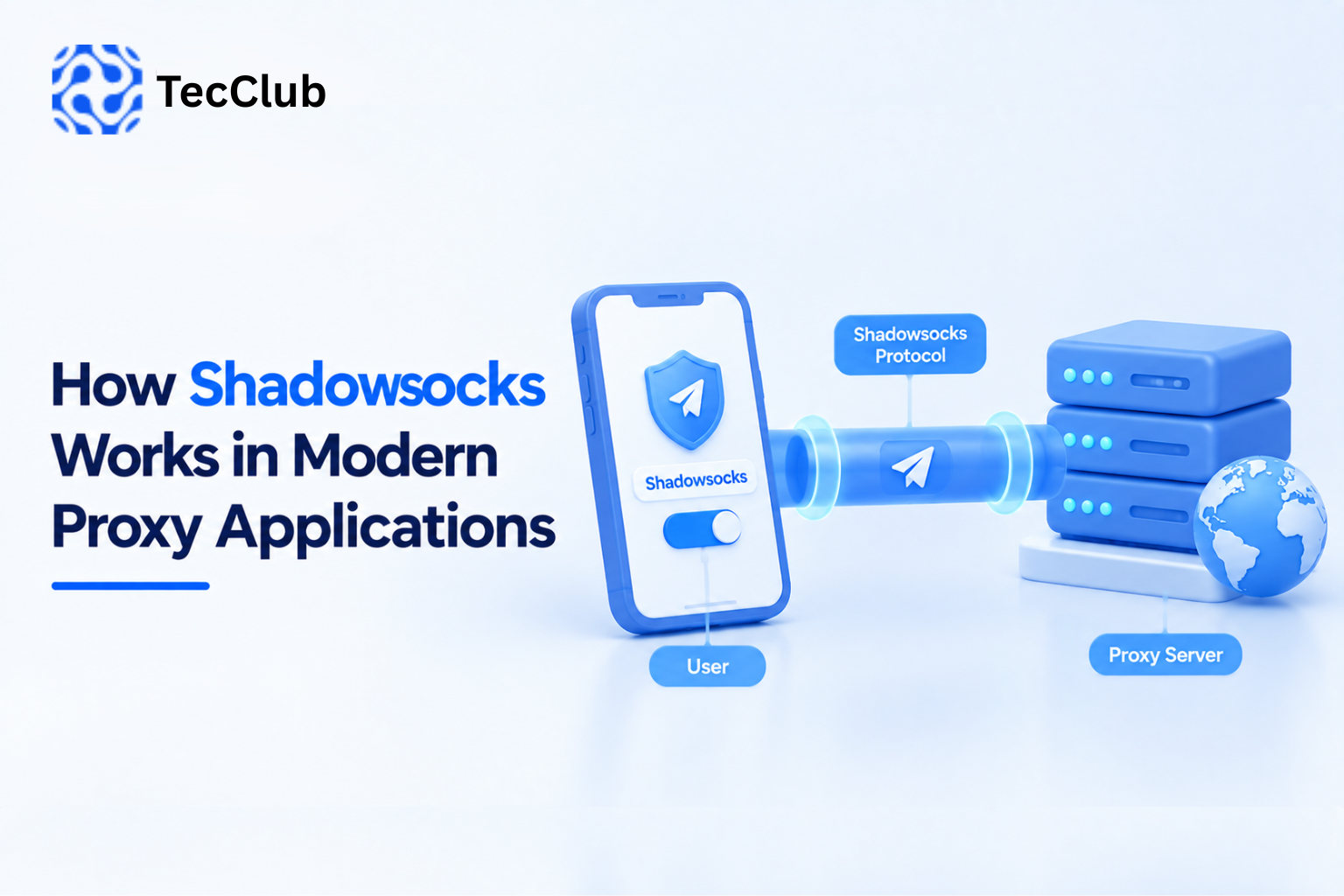
How Shadowsocks Works in Modern Proxy Applications
Modern proxy applications need to do more than simply move traffic from one endpoint to another. They often need to handle authentication, encryption, routing, multiple network environments, and different application requirements while remaining lightweight and responsive.
Shadowsocks is one technology that has been widely used for encrypted proxying. Its relatively simple architecture makes it useful in applications where developers need a proxy-based approach rather than a traditional full-tunnel VPN architecture.
For developers building modern VPN and proxy applications, understanding how Shadowsocks works is important because it can also appear alongside technologies such as Sing-box, V2Ray, VLESS, WireGuard, and other networking components.
This article explains what Shadowsocks is, how traffic flows through it, how encryption works at a high level, where it fits into modern proxy applications, and what developers should consider when integrating it into a larger platform.
1. What Is Shadowsocks?
Shadowsocks is an encrypted proxy protocol designed to relay network traffic between a client and a remote server.
A simplified architecture looks like this:
Application
     ↓
Shadowsocks Client
     ↓
Encrypted Connection
     ↓
Shadowsocks Server
     ↓
Internet
The client runs on the user's device, while the server operates remotely.
The application sends traffic to the Shadowsocks client. The client processes the traffic and sends it through the encrypted connection to the Shadowsocks server, which then forwards the traffic toward its destination.
This makes Shadowsocks fundamentally different from a traditional VPN tunnel in terms of architecture and intended use.
2. Shadowsocks vs a Traditional VPN
One of the easiest ways to understand Shadowsocks is to compare its general architecture with a VPN.
Traditional VPN
Device
   ↓
VPN Tunnel
   ↓
VPN Server
   ↓
Internet
A VPN can operate at the network layer and may route broad categories of device traffic through the tunnel.
Shadowsocks
Application / Proxy Traffic
          ↓
   Shadowsocks Client
          ↓
   Encrypted Proxy
          ↓
   Shadowsocks Server
          ↓
       Internet
The exact traffic scope depends on how the client application is configured.
For example, a modern application may use a local TUN interface to capture broader device traffic and then send selected traffic through a Shadowsocks outbound.
So the protocol itself should not be confused with the routing system around it.
3. How Shadowsocks Traffic Flows
A simplified request might look like this:
User Opens Website
       ↓
Local Application
       ↓
Traffic Captured / Proxied
       ↓
Shadowsocks Client
       ↓
Encryption
       ↓
Remote Shadowsocks Server
       ↓
Destination Website
The response travels in the opposite direction:
Destination Website
       ↓
Shadowsocks Server
       ↓
Encrypted Response
       ↓
Shadowsocks Client
       ↓
Local Application
The client and server therefore work together as two sides of the proxy connection.
4. The Client Side
The client is responsible for accepting traffic from the user's device or application and forwarding it through the Shadowsocks connection.
Depending on the application architecture, the client may receive traffic through:
-
SOCKS5
-
Local proxy settings
-
TUN interface
-
Application-specific proxy configuration
-
Another routing layer
A simplified architecture could be:
Applications
     ↓
TUN / SOCKS5
     ↓
Routing Engine
     ↓
Shadowsocks Outbound
     ↓
Remote Server
This is especially important in modern VPN applications because the Shadowsocks protocol may only represent one part of the overall traffic-processing architecture.
5. The Shadowsocks Server
The remote server receives the encrypted proxy traffic and processes it using the corresponding Shadowsocks configuration.
Conceptually:
Encrypted Traffic
       ↓
Shadowsocks Server
       ↓
Decrypt / Process
       ↓
Destination Connection
       ↓
Internet
The server then forwards traffic to the requested destination and sends the response back through the encrypted connection.
The server therefore needs suitable network connectivity, resource capacity, and configuration to handle the expected traffic volume.
6. Encryption and Authentication
Shadowsocks uses encryption to protect traffic between the client and server.
The exact cryptographic options depend on the implementation and configuration being used.
A simplified model is:
Plain Traffic
     ↓
Encryption
     ↓
Encrypted Data
     ↓
Network
     ↓
Decryption
     ↓
Original Data
The client and server need compatible configuration so they can establish and process the connection correctly.
Modern implementations can use authenticated-encryption approaches, which help provide confidentiality and integrity for the protected connection.
Developers should choose supported, appropriate encryption methods rather than treating every historical Shadowsocks cipher as equally suitable for a modern deployment.
7. What Is a Shadowsocks Configuration?
A Shadowsocks client generally needs enough information to identify and connect to its server.
Depending on the implementation, configuration can include information such as:
Server Address
Server Port
Encryption Method
Authentication Secret
Transport Options
A simplified conceptual configuration might look like:
Server: example.com
Port: 443
Method: Modern AEAD Method
Secret: ********
A production application should not expose sensitive credentials unnecessarily or store them insecurely.
8. Shadowsocks and SOCKS5
Shadowsocks is commonly associated with SOCKS5 proxying.
A local application may send traffic to a SOCKS5 interface:
Browser / App
      ↓
SOCKS5
      ↓
Shadowsocks Client
      ↓
Encrypted Connection
      ↓
Shadowsocks Server
This architecture is useful for applications that already understand SOCKS-based proxying.
However, a modern VPN application can also use a TUN interface and a routing engine to send broader device traffic through a Shadowsocks outbound.
9. Shadowsocks in Sing-box
One of the most useful modern architectures is combining Shadowsocks with a routing framework such as Sing-box.
Instead of treating Shadowsocks as the entire VPN application, developers can use it as one outbound inside a larger traffic-processing system.
For example:
Device Traffic
      ↓
TUN Inbound
      ↓
Sing-box Router
      ↓
┌─────┼──────────┐
↓     ↓          ↓
Direct Shadowsocks VLESS
      ↓
  Selected Route
This architecture allows different types of traffic to be handled differently.
For example:
-
Local domains → Direct
-
Selected traffic → Shadowsocks
-
Another traffic group → VLESS
-
Blocked domains → Block
This is one reason protocol-aware routing engines are useful in multi-protocol applications.
10. Routing Rules Matter
Shadowsocks itself does not have to determine every traffic decision.
A separate routing layer can decide where traffic should go.
For example:
Incoming Traffic
      ↓
Routing Rules
      ↓
 ┌────┼────────────┐
 ↓    ↓            ↓
Direct Shadowsocks Block
Routing rules can potentially consider:
-
Domain
-
IP address
-
Port
-
Application
-
Network interface
-
Geographic rules
-
User configuration
The exact capabilities depend on the routing engine and client implementation.
This separation makes the architecture easier to extend when multiple protocols are supported.
11. Shadowsocks and TUN Mode
A TUN interface provides a way for an application to process network traffic at the IP level.
A modern proxy/VPN application may therefore use:
Device
  ↓
TUN Interface
  ↓
Traffic Router
  ↓
Shadowsocks Outbound
  ↓
Remote Server
This is different from simply configuring individual applications to use a SOCKS proxy.
TUN-based architectures can provide broader device-level traffic handling while still allowing the routing engine to decide which traffic should use Shadowsocks.
12. Shadowsocks Is Only One Layer of the System
A common misunderstanding is thinking that the Shadowsocks protocol is responsible for everything.
In a modern application, several layers may exist:
Mobile/Desktop UI
       ↓
VPN Service / Network Layer
       ↓
TUN / SOCKS
       ↓
Routing Engine
       ↓
Protocol Outbound
       ↓
Transport
       ↓
Remote Server
       ↓
Internet
Shadowsocks may occupy only one part of this stack.
For example:
TUN
 ↓
Sing-box
 ↓
Shadowsocks
 ↓
Transport
 ↓
Remote Server
This distinction becomes important when designing a multi-protocol VPN application.
13. Transport and Protocol Are Not the Same Thing
Another important distinction is between a protocol and a transport.
Shadowsocks defines how proxy traffic is handled between compatible endpoints.
Transport concerns how data is carried across the network.
Conceptually:
Application
     ↓
Proxy Protocol
     ↓
Transport
     ↓
Network
Developers should avoid treating protocol and transport as interchangeable concepts.
The exact transport options available depend on the Shadowsocks implementation and surrounding software.
14. Server Performance and Capacity
A Shadowsocks server needs to process network traffic continuously.
Its capacity can be influenced by:
-
CPU
-
Memory
-
Network bandwidth
-
Concurrent connections
-
Packet rates
-
Encryption workload
-
Operating-system configuration
-
Server location
-
Network quality
A simplified monitoring model:
Shadowsocks Server
      ↓
CPU ────────┐
Memory ─────┤
Bandwidth ──┼──→ Monitoring
Connections ─┤
Errors ──────┘
For larger platforms, multiple servers may be deployed rather than relying on one node.
15. Using Multiple Shadowsocks Servers
A VPN or proxy platform may maintain multiple Shadowsocks nodes.
For example:
              Shadowsocks Cluster
                     ↓
        ┌────────────┼────────────┐
        ↓            ↓            ↓
     Server A     Server B     Server C
      Europe        Asia       America
The application can present these servers to users through a centralized backend.
The backend can maintain information such as:
-
Server location
-
Address
-
Port
-
Availability
-
Protocol support
-
Capacity
-
Configuration status
16. Dynamic Configuration Delivery
A modern proxy application does not necessarily need to hard-code every server configuration inside the application.
Instead:
User Logs In
     ↓
Backend API
     ↓
User / Subscription Validation
     ↓
Configuration Generated
     ↓
Application Receives Configuration
     ↓
Proxy Starts
This makes it easier to update server information without releasing a completely new application version every time infrastructure changes.
It can also help support subscription-based and white-label platforms.
17. Shadowsocks in Multi-Protocol VPN Applications
A modern VPN application may support several networking technologies.
For example:
VPN Application
       ↓
Traffic Router
       ↓
 ┌─────┼───────────┬─────────┐
 ↓     ↓           ↓         ↓
WireGuard OpenVPN Shadowsocks VLESS
Each technology can serve a different technical requirement.
This architecture allows a platform to provide multiple connection options while keeping the user experience inside one application.
The routing and configuration layers become particularly important as the number of supported protocols increases.
18. Shadowsocks for Mobile Applications
On Android and iOS, integrating proxy functionality requires more than simply implementing a server connection.
A mobile application may need to manage:
-
VPN/network permissions
-
Connection lifecycle
-
Background behavior
-
Network changes
-
Reconnection
-
DNS handling
-
Configuration updates
-
Battery usage
-
Error reporting
-
User interface state
A simplified architecture:
Mobile UI
   ↓
Connection Manager
   ↓
Network/VPN Service
   ↓
Proxy Engine
   ↓
Shadowsocks
   ↓
Remote Server
The UI should remain separate from the underlying connection engine so that connection state can be managed reliably.
19. Handling Network Changes
Mobile users frequently switch between:
Wi-Fi
  ↕
Cellular
A proxy application needs to recognize that the underlying network may have changed.
A reliable connection architecture can detect the change and determine whether it needs to:
-
Reconnect
-
Re-establish the tunnel
-
Refresh DNS
-
Select another server
-
Update routing
-
Report the connection state
This is particularly important for applications intended for mobile users.
20. DNS Handling
DNS is another important part of proxy application architecture.
A simplified traffic flow might be:
Application
    ↓
DNS Request
    ↓
Routing / DNS Layer
    ↓
Configured Resolver
The exact DNS design depends on whether DNS requests are sent through the proxy, handled locally, routed separately, or processed by a dedicated DNS component.
A well-designed application should ensure that its DNS behavior matches the intended privacy and routing model.
21. Connection Monitoring
A production application should not assume that a connection remains healthy simply because it was initially established.
The system can monitor states such as:
Disconnected
    ↓
Connecting
    ↓
Connected
    ↓
Reconnecting
    ↓
Disconnected
Additional information can include:
-
Connection duration
-
Server status
-
Network changes
-
Error conditions
-
Reconnection attempts
-
User-initiated disconnects
This allows the UI and backend systems to represent connection state more accurately.
22. Security Considerations
When implementing Shadowsocks, developers should consider security at multiple levels.
Important areas include:
-
Secure credential handling
-
Modern cryptographic configurations
-
Secure server access
-
TLS where applicable to the surrounding architecture
-
Configuration protection
-
API authentication
-
Secure updates
-
Server hardening
-
Access control
-
Monitoring
A secure proxy architecture is not created simply by selecting an encrypted protocol.
The application, API, server, configuration system, and infrastructure all need appropriate security controls.
23. Shadowsocks vs WireGuard
Shadowsocks and WireGuard solve different problems.
| Feature | Shadowsocks | WireGuard |
|---|---|---|
| General model | Encrypted proxy | VPN tunnel |
| Typical use | Proxy traffic | Network-layer VPN |
| Architecture | Client/server proxy | VPN tunnel endpoints |
| Routing | Often handled by proxy/router | Integrated with VPN routing |
| Common integration | SOCKS/TUN/routing engines | Native VPN interfaces |
| Multi-protocol apps | Useful as one outbound | Useful as one VPN option |
| Main design focus | Proxying | Secure network tunneling |
Neither should automatically be considered a replacement for the other.
The appropriate choice depends on the application's architecture and requirements.
24. Common Mistakes When Using Shadowsocks
Treating It as a Complete VPN Platform
The protocol is only one component of the overall product.
Ignoring the Routing Layer
Traffic routing becomes increasingly important when an application supports multiple protocols.
Using Outdated Configurations
Developers should evaluate currently supported cryptographic methods rather than blindly copying old configurations.
Hard-Coding Server Credentials
Sensitive configuration should be handled securely.
Ignoring Mobile Network Changes
Wi-Fi and cellular transitions can affect long-running connections.
Forgetting Capacity Planning
A proxy server can become a bottleneck when traffic grows.
No Monitoring
Without monitoring, connection failures and server overload can be difficult to diagnose.
25. A Practical Modern Shadowsocks Architecture
A complete application might look like this:
                 Mobile / Desktop App
                          ↓
                    VPN Service
                          ↓
                     TUN / SOCKS
                          ↓
                    Routing Engine
                          ↓
             ┌────────────┼────────────┐
             ↓            ↓            ↓
          Direct      Shadowsocks      VLESS
                          ↓
                  Transport Layer
                          ↓
                  Shadowsocks Node
                          ↓
                       Internet
Behind the application, the management system may look like:
Admin Dashboard
       ↓
Backend API
       ↓
Configuration Service
       ↓
Server Management
       ↓
Shadowsocks Nodes
This separates user-facing functionality from infrastructure management.
26. How TecClub Technology Can Build Shadowsocks-Based Applications
At TecClub Technology, Shadowsocks can be integrated as part of a broader VPN or proxy application rather than treated as an isolated feature.
A solution can include:
-
Android and iOS applications
-
Windows and macOS applications
-
Shadowsocks integration
-
Sing-box integration
-
VLESS support
-
WireGuard support
-
OpenVPN support
-
IKEv2/IPsec support
-
TUN-based traffic routing
-
SOCKS5 support
-
Server management
-
Dynamic configuration delivery
-
Subscription management
-
User and device management
-
Admin dashboard
-
Server health monitoring
-
Load balancing
-
Connection-state management
-
Backend APIs
-
White-label VPN infrastructure
This approach allows businesses to build a product around their own branding while keeping protocol, routing, backend, and infrastructure components organized separately.
Conclusion
Shadowsocks is best understood as an encrypted proxy technology, not simply another name for a traditional VPN.
Its architecture can be relatively lightweight, while modern networking frameworks can extend its capabilities through routing, TUN interfaces, multiple outbounds, dynamic configurations, and multi-protocol support.
A modern application might combine:
TUN / SOCKS
     ↓
Routing Engine
     ↓
Shadowsocks
     ↓
Transport
     ↓
Remote Server
For developers, the key is understanding where Shadowsocks fits within the complete architecture.
When combined with appropriate routing, backend management, server infrastructure, monitoring, and secure configuration practices, it can become one component of a flexible modern proxy or VPN application.