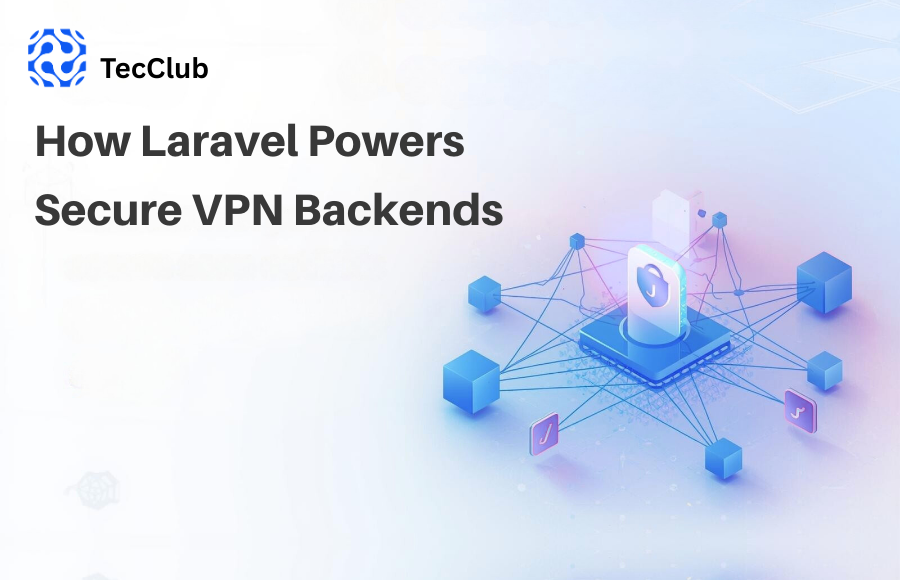
How Laravel Powers Secure VPN Backends
When most people think about VPNs, they picture a big “Connect” button, a list of servers, and maybe a speed indicator. If it connects fast and stays stable, they’re happy—and honestly, that’s how it should be.
But behind that simple experience is a backend system doing a lot of quiet, critical work.
At TecClub Technology, we use Laravel to build the backend brains of our VPN platforms. It’s not flashy, and users never see it—but it’s one of the main reasons everything feels smooth, secure, and reliable.
Let’s take a look at why the backend matters so much—and why Laravel fits perfectly into that role.
The VPN Backend Is the Unsung Hero
A VPN backend isn’t just a database with user accounts. It’s the control room that keeps everything running safely.
It handles things like:
-
Who is allowed to connect
-
How many devices can be used
-
Which servers are available
-
What protocol or security rules apply
-
How apps communicate with the system
If this layer fails—or is poorly designed—no amount of strong encryption can save the experience.
That’s why we take backend architecture seriously.
Why We Trust Laravel for VPN Systems
Laravel isn’t just popular—it’s dependable.
We choose Laravel because it helps us build systems that are:
-
Clean and well-structured
-
Secure by default
-
Easy to scale as users grow
-
Flexible enough for advanced VPN features
In a product where trust matters, predictability and stability go a long way.
Authentication That Actually Feels Secure
Logging into a VPN shouldn’t feel complicated—but behind the scenes, it must be airtight.
Using Laravel, we build authentication systems that:
-
Use secure, token-based access
-
Track active sessions and devices
-
Enforce limits and rules consistently
-
Prevent unauthorized access
The goal is simple: users connect smoothly, while the system quietly enforces the rules.
Built API-First for Modern VPN Apps
VPN apps don’t work without constant communication with the backend.
Laravel helps us build clean, reliable APIs that:
-
Work smoothly with Flutter, Android, iOS, and web apps
-
Respond quickly and consistently
-
Handle errors gracefully
-
Stay secure under pressure
This keeps the app experience fast and predictable—even when thousands of users are connecting at once.
Privacy Isn’t a Feature—It’s a Design Choice
A privacy-focused VPN backend should collect as little data as possible.
That’s exactly how we design our Laravel systems.
We focus on:
-
Storing only what’s truly necessary
-
Protecting credentials properly
-
Encrypting sensitive fields
-
Limiting who and what can access user data
Less data means less risk—and more trust from users.
Scaling Without Breaking Things
As VPN platforms grow, things can get messy fast.
Laravel helps us scale without chaos by allowing us to:
-
Add servers without reworking the system
-
Handle traffic spikes smoothly
-
Introduce new features safely
-
Maintain performance under load
Users never notice the growth—and that’s the point.
Security Is Built In (and Built On)
Laravel already protects against common threats like:
-
SQL injection
-
Cross-site scripting
-
CSRF attacks
We build on top of that with VPN-specific safeguards, creating multiple layers of defense. Security isn’t one feature—it’s a mindset baked into the backend.
Keeping the Platform Healthy
A good backend doesn’t just serve users—it protects itself.
We use Laravel to implement:
-
Smart rate limiting
-
Abuse detection
-
Activity monitoring
-
Safe logging that avoids sensitive data
This keeps the platform stable while respecting user privacy.
Powering the Features Users Rely On
Many “VPN features” actually live in the backend.
Laravel helps us manage:
-
Subscription and billing logic
-
Protocol and configuration rules
-
Server availability
-
Kill switch behavior
-
Usage policies
The app may look simple—but the backend is coordinating everything behind the scenes.
Why We Build VPN Backends This Way
At TecClub Technology, we don’t just build VPNs—we build trust systems.
Laravel helps us:
-
Move fast without cutting corners
-
Keep code readable and maintainable
-
Adapt to changing security needs
-
Deliver long-term reliability
In VPN products, users may never see the backend—but they feel it every time they connect.
Final Thoughts
A VPN is more than an app or a protocol. It’s an ecosystem—and the backend is its backbone.
By using Laravel, we create VPN systems that are secure, scalable, and quietly dependable. No drama. No surprises. Just solid infrastructure doing its job.
At TecClub Technology, that’s exactly how we believe privacy technology should work:
strong where it matters, invisible where it doesn’t.