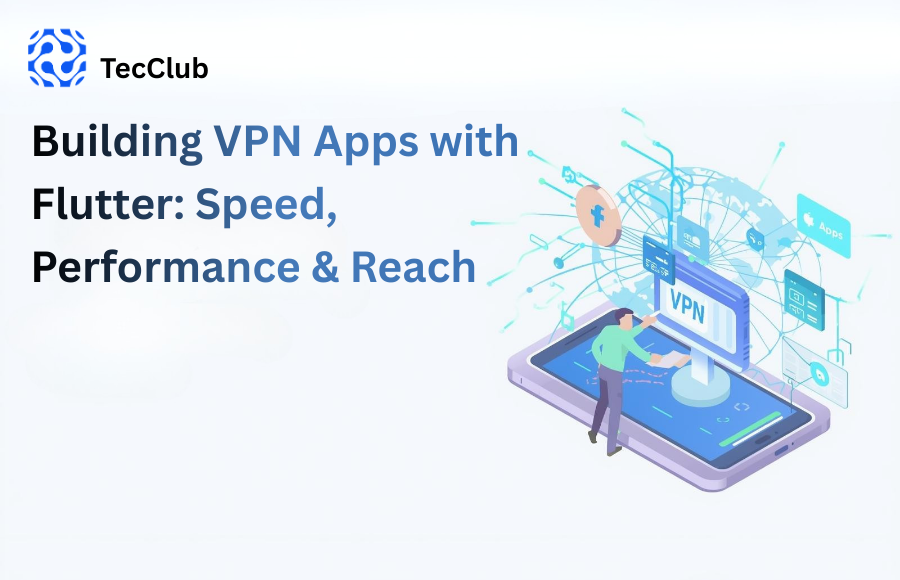
Building VPN Apps with Flutter: Speed, Performance & Reach
Let’s be honest—most people don’t download a VPN because they’re excited about technology. They download it because they want to feel safe, stay connected, and not deal with problems.
They want to tap a button and trust that everything just works.
On the other side, businesses want VPN apps that are:
-
Fast to build
-
Easy to update
-
Reliable across devices
This is where Flutter quietly does a lot of heavy lifting.
At TecClub Technology, we use Flutter to build VPN apps that feel smooth, dependable, and easy to use—without sacrificing performance or security. Here’s why it works so well in the real world.
VPN Apps Have to Work Even When Everything Else Doesn’t
VPNs are often used in the worst network conditions:
-
Weak Wi-Fi
-
Public hotspots
-
Constant network switching
-
Background usage
So the app can’t freeze, lag, or behave unpredictably.
Flutter gives us a strong, stable UI layer that stays responsive—even while the VPN engine is doing complex work in the background. The app feels calm and reliable, which is exactly what users want when security is involved.
One App, Same Experience Everywhere
Nothing breaks trust faster than an app that behaves differently on each device.
With Flutter, we can:
-
Build a single codebase for Android and iOS
-
Keep features perfectly aligned
-
Maintain the same look, flow, and behavior
For users, that means fewer surprises. For businesses, it means faster updates and fewer headaches.
It Feels Native—Because It Basically Is
A lot of people assume cross-platform apps feel “off.” Flutter proves otherwise.
Because Flutter compiles to native code:
-
Screens load quickly
-
Buttons respond instantly
-
Animations feel smooth and natural
Even during things like server switching or reconnecting, the app stays responsive. No lag. No confusion. No “is this stuck?” moments.
Designed for Real Humans, Not Just Screens
VPN apps shouldn’t feel technical. They should feel reassuring.
Using Flutter, we focus on:
-
Clear connect/disconnect states
-
Simple server selection
-
Easy-to-understand security indicators
-
Settings that don’t overwhelm
The goal is simple: users should always know what’s happening—without needing to understand how VPNs work.
Background Reliability Is Non-Negotiable
A VPN that stops working when the app is minimized isn’t really protecting anyone.
That’s why we pair Flutter with native system services to handle:
-
Background connectivity
-
Auto-reconnect logic
-
Kill switch enforcement
-
Network changes
Flutter takes care of what users see. Native layers take care of what must never fail.
Security Is Built In, Not Bolted On
Flutter doesn’t weaken security—it stays out of the way of it.
We design our apps so:
-
Sensitive operations stay in native code
-
Communication between layers is secure
-
Permissions and encryption are handled properly
The result is a VPN app that feels friendly on the surface, but is serious under the hood.
Faster Development = Better Apps
Flutter helps us move faster—but not recklessly.
Faster iteration means:
-
Bugs get fixed sooner
-
Features improve continuously
-
Users don’t wait months for updates
That speed isn’t just good for us—it directly improves the user experience.
Built for a Global Audience
VPN users come from everywhere, and Flutter makes it easier to support that reality.
We can:
-
Add new languages smoothly
-
Support dark mode naturally
-
Adapt layouts for different screen sizes
That flexibility helps VPN products scale without becoming messy or inconsistent.
Why Flutter Works for Us
We didn’t choose Flutter because it’s trendy. We chose it because it makes life better—for users and developers.
It helps us:
-
Build reliable VPN apps
-
Maintain high security standards
-
Deliver consistent experiences
-
Scale products without chaos
In short, it lets us focus on privacy and performance, not platform problems.
Final Thoughts
Flutter isn’t just a development tool—it’s a practical choice for building VPN apps that people actually enjoy using.
When combined with strong VPN protocols, secure architecture, and thoughtful design, it helps create apps that feel fast, trustworthy, and stress-free.
At TecClub Technology, we use Flutter to build VPN apps that quietly do their job—so users don’t have to think about security at all. And honestly, that’s the best compliment a VPN can get.