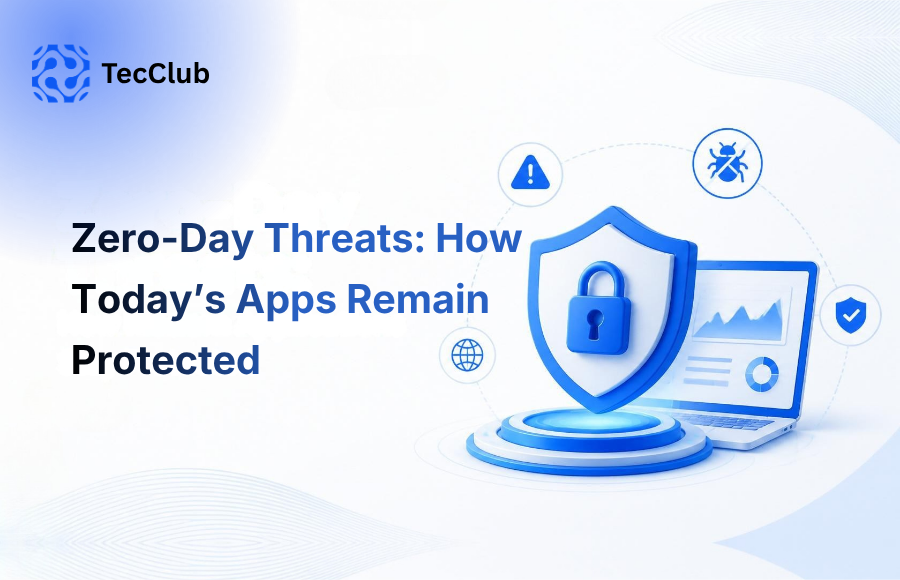
Zero-Day Threats: How Today’s Apps Remain Protected
Cyber risks are ever-evolving, and some of the most dangerous attacks exploit vulnerabilities that the developers are not even aware of. These are known as zero-day threats—security flaws that attackers discover and exploit before a fix or patch becomes available.
For businesses, a successful zero-day attack can lead to data breaches, service disruptions, financial losses, and damage to customer trust. That's why modern application security focuses not only on preventing known threats but also on minimizing the impact of unknown ones.
At TecClub Technology, we build secure applications using layered security strategies that help businesses stay resilient against both known and emerging cyber threats.
Zero-day threats and the way modern apps are built to stay protected. Let’s explore.
Definition of a Zero-Day Threat
A zero-day threat occurs when attackers exploit a software vulnerability before the software vendor or development team has released a security update.
The term "zero-day" refers to the fact that developers have had zero days to fix the vulnerability before it is used in an attack.
These threats are particularly challenging because traditional security tools may not yet recognize them.
Why Zero-Day Threats Are Dangerous
Unlike known vulnerabilities, zero-day exploits can bypass conventional defenses because there is no existing signature or patch.
Potential consequences include:
Data breaches
Unauthorized system access
Service disruption
Financial loss
Damage to reputation
For businesses that manage sensitive customer data, early detection and rapid response are essential.
1. Secure Software Development
The first line of defense is writing secure code in the first place.
Secure development practices include:
Secure coding standards
Code reviews
Static code analysis
Manage dependencies
Security testing throughout development
Reducing vulnerabilities early lowers the overall attack surface.
2. Defense in Depth
No single security measure can stop every attack.
Modern applications use multiple layers of protection, including:
Authentication Authorization Encryption Firewalls
Network monitoring Endpoint protection
If one layer is bypassed, additional controls help limit the attack.
3. Regular Security Updates
Although zero-day vulnerabilities cannot be patched before they're discovered, maintaining up-to-date software reduces exposure to previously identified threats.
Organizations should:
Apply security patches promptly
Update third-party libraries
Remove unsupported software
Monitor vendor security advisories
A strong patch management process strengthens overall security.
4. Runtime Threat Detection
Modern applications are not only focused on prevention but also look for suspicious behavior.
Runtime monitoring can detect:
Unusual login attempts
Unexpected system changes
Abnormal network traffic
Unauthorized access attempts
Behavior-based detection helps identify attacks that traditional signature-based tools might miss.
5. Principle of Least Privilege
Applications should give users and systems only the permissions they need.
This limits the potential impact if an attacker gains access.
Examples include:
Role-based access control
Limited administrator accounts
Restricted service permissions
Temporary elevated privileges
Smaller permission scopes reduce security risks.
6. Strong Authentication
Modern authentication adds another layer of protection against unauthorized access.
Best practices include:
Multi-Factor Authentication (MFA)
Biometric login
Secure session management
Passwordless authentication where appropriate
Even if credentials are compromised, additional verification helps protect accounts.
7. Secure API Protection
APIs are a common target for attackers.
Modern applications secure APIs through:
Authentication and authorization
Input validation
Rate limiting
Encrypted communication
Continuous monitoring
Protecting APIs reduces the likelihood of attackers exploiting backend services.
8. Continuous Security Monitoring
Security teams use monitoring tools to detect potential threats in real time.
Common monitoring activities include:
Log analysis
Threat intelligence
Anomaly detection Infrastructure monitoring
Automated alerts
Rapid detection enables faster incident response.
9. Isolating Critical Systems
Modern architectures often isolate sensitive components to reduce the spread of an attack.
Techniques include:
Network segmentation
Containerization
Separate application services
Isolated databases
If one component is compromised, the rest of the system remains better protected.
10. Cloud Security Best Practices
Cloud-native applications benefit from built-in security capabilities such as:
Identity and access management
Encryption
Automated backups
Security monitoring Infrastructure redundancy
Combined with secure application design, these features improve resilience against emerging threats.
11. Employee Awareness Matters
Technology alone cannot eliminate security risks.
Organizations should educate employees about:
Phishing attempts
Social engineering
Secure password practices
Safe file sharing
Reporting suspicious activity
An informed workforce strengthens overall cybersecurity.
12. Preparing for the Unexpected
Since zero-day vulnerabilities cannot always be prevented, businesses should have a response plan.
A strong incident response strategy includes:
Backup and recovery procedures
Security monitoring
Rapid vulnerability assessment
Communication plans
Post-incident reviews
Preparation helps minimize downtime and business impact.
How TecClub Technology Builds Secure Applications
At TecClub Technology, we develop applications using a security-first approach that includes:
Secure software development practices
Layered security architecture
Secure API implementation
Continuous monitoring
Cloud security best practices
Role-based access control
Regular security testing
Our goal is to help businesses build resilient applications that remain secure in an evolving threat landscape.
Best Practices for Reducing Zero-Day Risk
To strengthen protection against zero-day threats, organizations should:
Follow secure coding standards throughout development.
Keep operating systems, frameworks, and third-party libraries up to date.
Implement Multi-Factor Authentication (MFA).
Monitor systems continuously for unusual activity.
Use the principle of least privilege for users and services.
Segment critical systems to limit the impact of breaches.
Regularly perform security assessments and penetration testing.
Maintain an incident response and disaster recovery plan.
While no system can eliminate every risk, these practices significantly improve resilience.
Conclusion
Zero-day threats remind us that cybersecurity is an ongoing process, not a one-time task. By combining secure development practices, layered defenses, continuous monitoring, and proactive incident response, organizations can reduce the impact of unknown vulnerabilities and strengthen their overall security posture.
At TecClub Technology, we build modern applications with security at every layer—helping businesses stay protected against today's threats while preparing for tomorrow's challenges.