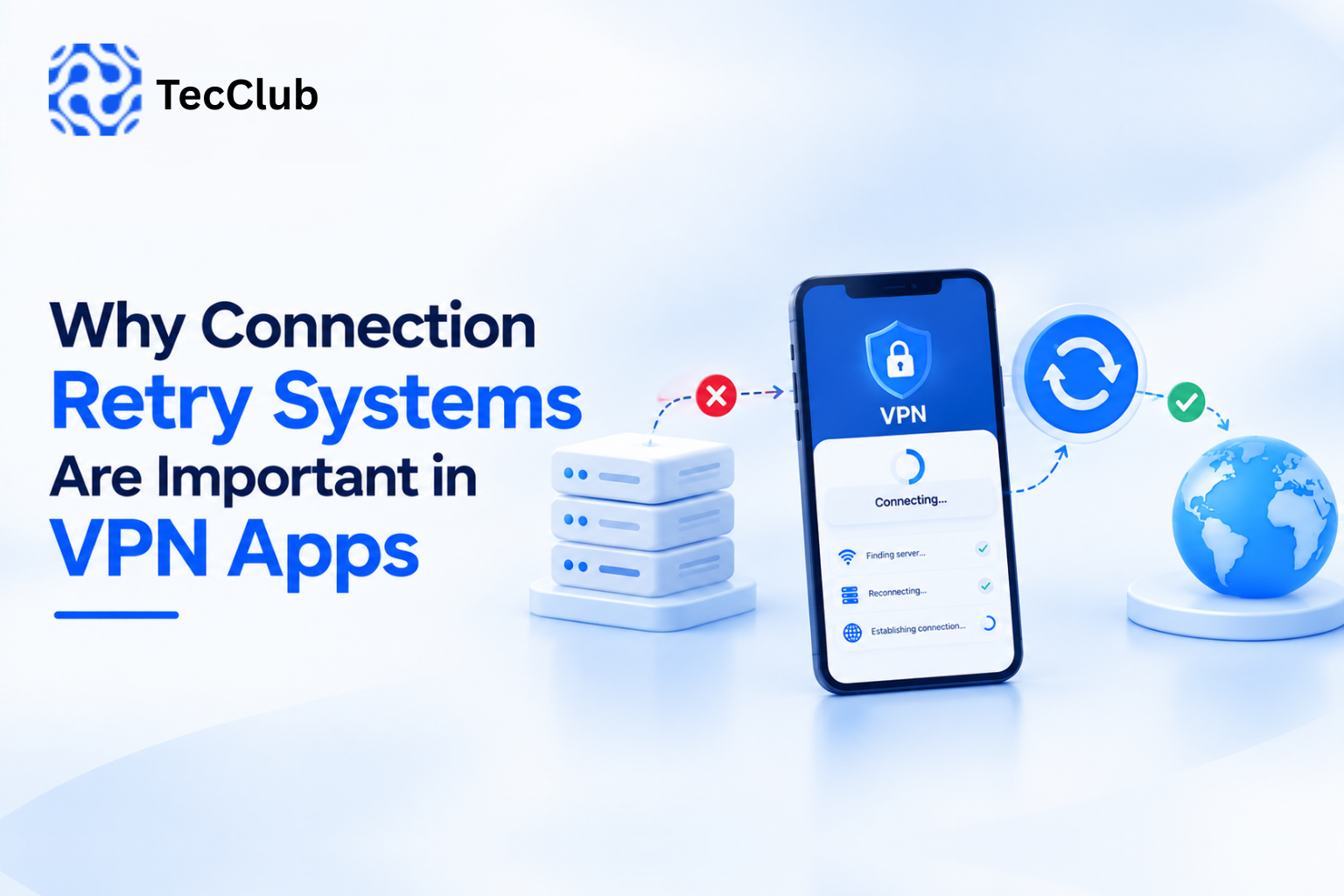

The Hidden Role of Background Services in VPN Stability
Most people judge a VPN app by what they can see.
A big “Connect” button.
A list of servers.
Maybe how fast it feels.
And that’s fair.
But honestly… none of that is what actually keeps a VPN stable.
The real work happens quietly, in the background — in parts of the app users never even notice.
That’s where background services come in.
At TecClub Technology, we spend a lot of time getting this part right. Because no matter how clean the interface looks, if the background systems aren’t solid, the whole experience falls apart.
So, What Are Background Services?
Think of them as the “always-on” part of the VPN.
Even when you’re not looking at the app… even when your phone is locked… they’re still running.
They’re responsible for things like:
- Keeping your VPN connected
- Watching for network changes
- Reconnecting when something breaks
- Making sure your security is still active
Without them, your VPN would only work when the app is open — and the moment you switch apps or lose signal, you’d be exposed.
Keeping the Connection Alive (Even When You Forget About It)
You don’t sit there watching your VPN all day — and you shouldn’t have to.
That’s why background services make sure the connection stays alive no matter what you’re doing.
Scrolling social media, watching videos, locking your phone… it doesn’t matter.
Behind the scenes:
- The tunnel stays active
- The connection doesn’t quietly drop
- Everything keeps running as expected
So you stay protected without thinking about it.
Fixing Problems Before You Notice Them
Let’s be real — networks are messy.
Wi-Fi cuts out.
Mobile data kicks in.
Signals drop for a second.
Normally, that would break a connection.
But here’s where background services really shine.
They detect those tiny disruptions instantly… and fix them just as fast.
Reconnect. Restore. Continue.
Most of the time, you don’t even realize anything went wrong.
Always Watching the Connection
A good VPN doesn’t just connect and hope for the best — it keeps watching.
Background services are constantly checking:
- Is the connection still stable?
- Is it getting slower?
- Is the server responding properly?
If something feels off, the system adjusts.
That’s what keeps things smooth instead of frustrating.
Making Protocol Switching Invisible
Modern VPNs use different protocols like:
- WireGuard
- OpenVPN
But switching between them can be tricky — unless it’s handled properly.
Background services take care of that.
They:
- Switch protocols silently
- Choose better options when needed
- Keep everything stable during the transition
From the user’s side, nothing changes — it just keeps working.
Keeping Security Locked In (All the Time)
Security isn’t something that should depend on user action.
It needs to stay active constantly.
That’s why background services are always enforcing things like:
- Kill switch protection
- DNS leak prevention
- Secure routing
- Session safety
If the VPN drops even for a moment, they step in immediately to block traffic and protect your data.
No gaps. No exposure.
Running Smart Routing in the Background
Modern VPNs aren’t just “on or off” anymore.
They make decisions — like where your traffic should go and how it should be handled.
Using systems like Sing-box, background services manage:
- Which traffic goes where
- Domain-based rules
- Split tunneling
- MultiHop routing
All of this happens continuously, without any input from the user.
Quietly Improving Performance
Speed isn’t just about having a good server — it’s about constant adjustment.
Background services help by:
- Switching to better servers when needed
- Balancing connection load
- Triggering protocol changes
- Reducing delays
This is why a good VPN feels smooth instead of slow or inconsistent.
Not Killing Your Battery
Here’s the tricky part — all of this needs to happen without draining your phone.
So background services have to be efficient.
We design them to:
- Use minimal battery
- Avoid unnecessary activity
- Stay within system limits
Because a VPN that kills your battery isn’t practical.
Why You Never Think About Them
Here’s the funny thing — if background services are working perfectly, you’ll never notice them.
And that’s exactly how it should be.
Because when they work:
- The VPN feels stable
- Connections don’t randomly drop
- Everything just runs smoothly
But when they don’t… you feel it immediately.
How We Approach It at TecClub Technology
At TecClub Technology, we treat background systems as the core of the VPN — not an afterthought.
We build them to:
- Handle real-world network issues
- Support multi-protocol systems
- Keep security active at all times
- Continuously adjust for performance
Because at the end of the day, stability isn’t about what users see — it’s about what they don’t have to worry about.
Final Thoughts
A VPN might look simple on the surface.
But what makes it truly reliable is everything happening behind the scenes.
Background services are what keep the connection alive, fix problems instantly, enforce security, and adapt to constant changes — all without interrupting the user.
At TecClub Technology, that’s the goal:
Make the complex parts invisible…
and let the user just enjoy a stable, secure connection without ever thinking about it.