If you’ve ever used a fast, stable VPN and thought, “this just works” — there’s a good chance something powerful is running underneath.
And in many modern VPN apps, that “something” is Sing-box.
It’s not flashy. Users never see it. But it plays a huge role in how fast, stable, and flexible a VPN actually feels.
At TecClub Technology, we use Sing-box as a core building block when designing high-performance VPN apps — mainly because it gives us speed without unnecessary complexity.
Let’s break down what makes it so effective.
What Is Sing-box (In Simple Terms)?
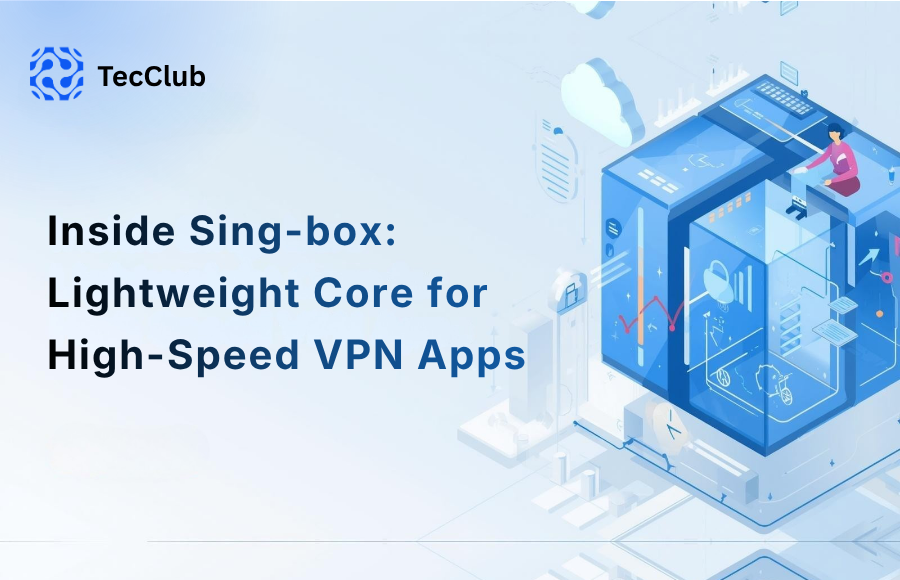
Think of Sing-box as the engine of a VPN app.
It’s the part that handles:
- How traffic is routed
- Which protocol is used
- How connections are managed
- How efficiently everything runs
Instead of stitching together multiple tools, Sing-box brings everything into one clean, unified system.
And that makes a big difference.
Why “Lightweight” Actually Matters
When we say Sing-box is lightweight, we don’t just mean “small.”
We mean it doesn’t waste resources.
It’s designed to:
- Use less CPU
- Consume less memory
- Handle connections efficiently
And that directly translates to:
- Faster performance
- Better battery life on mobile
- Smoother overall experience
Because at the end of the day, every extra bit of processing slows things down.
Built for Speed From the Ground Up
Speed isn’t something added later — it’s part of how Sing-box is built.
It handles:
- Fast connection setups
- Efficient packet processing
- Minimal overhead
So instead of feeling like your traffic is being “processed,” it just flows naturally.
That’s why apps built on it often feel quicker and more responsive.
One Core, Multiple Protocols
One of the biggest advantages of Sing-box is that it supports multiple protocols in a single system.
Things like:
- WireGuard
- Shadowsocks
- V2Ray
Instead of managing each one separately, everything runs through the same core.
That means:
- Less complexity
- Faster switching between protocols
- Better overall performance
Smart Routing Without the Mess
Routing is where a lot of VPNs either shine… or struggle.
Sing-box makes it flexible without making it complicated.
It allows:
- Domain-based routing
- Geo-based rules
- Split tunneling
- Custom traffic handling
So instead of treating all traffic the same, the system can make smarter decisions in real time.
Designed for Real-World Conditions
Networks aren’t perfect.
Sometimes they’re fast. Sometimes they’re unstable. Sometimes things get blocked.
Sing-box is built to handle that.
It adapts by:
- Switching protocols when needed
- Adjusting routing rules
- Maintaining stable connections
So even when conditions change, the VPN doesn’t fall apart.
Works Smoothly on Mobile Devices
Mobile performance is where a lot of VPN cores struggle.
But Sing-box is designed to stay efficient even on phones.
It helps with:
- Lower battery usage
- Stable background operation
- Smooth reconnections
Which is critical, because mobile users expect things to just work — without draining their device.
Easy to Scale, Easy to Control
From a development point of view, Sing-box also makes life easier.
It supports:
- Backend-controlled configurations
- Real-time updates
- Flexible deployment
So VPN apps can:
- Adjust settings without app updates
- Respond to network conditions instantly
- Scale as the user base grows
Why We Use Sing-box at TecClub Technology
At TecClub Technology, we focus on building VPN apps that feel simple — but are powerful underneath.
Sing-box helps us do exactly that.
We use it to:
- Combine multiple protocols into one system
- Optimize routing and performance
- Keep resource usage low
- Deliver consistent speed and stability
It gives us the flexibility we need without overcomplicating the architecture.
Final Thoughts
A high-speed VPN isn’t just about servers or encryption — it’s about what’s running at the core.
And that’s where Sing-box stands out.
It’s lightweight, flexible, and built for real-world performance — which makes it a strong foundation for modern VPN apps.
At TecClub Technology, we use tools like Sing-box to turn complex systems into something users don’t have to think about.
Because when everything is working right…
the best experience is the one you don’t even notice.