Let’s be honest — VPN apps today are way more complex than they used to be.
People are connecting from everywhere: home Wi-Fi, mobile data, public hotspots… and on top of that, different networks behave differently. Some are fast, some are restricted, some block certain protocols completely.
And still — users expect everything to just work. Fast, stable, no issues.
That’s why relying on a single protocol just doesn’t cut it anymore.
This is exactly where Sing-box comes in.
At TecClub Technology, we use Sing-box as the core of our VPN systems because it handles all this complexity in a really smart and efficient way — without making things heavy or slow.
Let’s walk through it in a simple, real-world way.
What Is Multi-Protocol Routing?
Think of it like this:
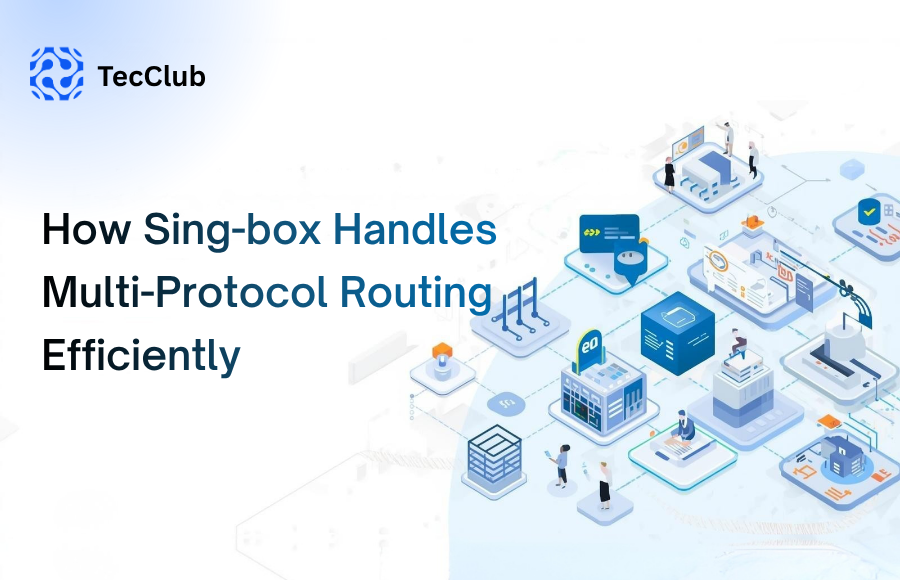
Instead of forcing all your internet traffic through one road, the VPN has multiple routes — and it chooses the best one depending on the situation.
So with multi-protocol routing, the system can:
- Use different protocols at the same time
- Decide how traffic should be handled
- Switch things around if conditions change
It’s not rigid. It adapts.
One System, Multiple Protocols
What makes Sing-box really powerful is that it doesn’t treat protocols as separate pieces.
It brings everything together into one system.
It works with things like:
- WireGuard
- Shadowsocks
- V2Ray
But instead of juggling them separately, it manages them all in one place.
That means less complexity behind the scenes — and better performance overall.
Smart Routing (The Real Magic)
This is where things get interesting.
Sing-box can make decisions based on rules like:
- What website you’re visiting
- Where the traffic is going
- What kind of connection is needed
So for example:
- Watching videos? → use a faster protocol
- Accessing restricted content? → switch to a stealth one
- Using local services? → skip the VPN for better speed
All of this happens automatically.
The user doesn’t have to think about it — it just feels fast and smooth.
It Adapts in Real Time
Networks change all the time. A connection that’s fast right now might slow down in a few seconds.
Sing-box keeps an eye on things like:
- Latency
- Stability
- Packet loss
- Server performance
And if something isn’t working well?
It adjusts. Instantly.
Switches protocol, changes route — whatever is needed — usually without the user even noticing.
Lightweight (But Powerful)
You might think handling all this would make the system heavy — but that’s not the case.
Sing-box is actually very lightweight.
It manages:
- CPU usage
- Memory
- Connections
in a very efficient way.
That’s why it works so well for:
- Mobile apps
- Large VPN platforms
- High-traffic environments
It stays fast, even when things get busy.
Works Smoothly with Advanced Features
Modern VPN apps come with features like:
- Split tunneling
- MultiHop
- Custom DNS
- Smart server selection
All of these depend on smart routing.
And Sing-box fits right in — it makes sure everything works together smoothly instead of clashing or slowing down.
Handles Restrictions Better
Some networks are strict. They block certain protocols or try to detect VPN traffic.
Sing-box handles this really well.
It can:
- Switch to another protocol if one gets blocked
- Change how traffic looks
- Keep the connection stable
So even in restricted environments, the VPN keeps working.
Controlled from the Backend
Another big advantage? Flexibility.
With Sing-box, a lot of things can be controlled from the backend.
That means:
- You can update routing rules anytime
- Change how protocols behave
- Optimize for specific regions
- Fix issues quickly without app updates
This makes the whole system much more responsive and future-proof.
How We Use It at TecClub Technology
At TecClub Technology, we use Sing-box to build VPN systems that actually perform well in real-world situations — not just in ideal conditions.
We focus on:
- Combining multiple protocols into one clean system
- Using smart routing instead of fixed logic
- Adjusting performance dynamically
- Keeping everything secure without slowing things down
The goal is simple: users shouldn’t have to think about any of this.
It should just work.
Final Thoughts
Multi-protocol routing isn’t just a “nice feature” anymore — it’s a necessity.
And Sing-box handles it in a way that feels natural, efficient, and reliable.
It brings together smart routing, real-time adaptability, and lightweight performance — all in one system.
At TecClub Technology, we use it to build VPN solutions that adjust to users automatically… instead of expecting users to adjust to the technology.