
When people talk about VPN apps, they usually focus on the “serious” stuff—security, encryption, servers.
But here’s the thing most people don’t realize:
👉 If the app itself feels confusing or annoying… none of that matters.
Because users don’t interact with the backend.
They interact with the screen in front of them.
And if that experience isn’t smooth, they’ll leave—simple as that.
At TecClub Technology, we spend a lot of time thinking about this exact problem:
How do you take something complex and make it feel ridiculously simple?
The Real Challenge: Hiding Complexity
VPNs are complicated. There’s no way around it.
But users don’t want to learn a VPN—they just want it to work.
So instead of explaining things like protocols or encryption, we:
- keep the interface clean
- remove unnecessary options
- give users one clear action: Connect
Everything else? Happens quietly in the background.
Keeping Users in the Loop (Without Overwhelming Them)
Connections aren’t always perfect.
Sometimes the VPN is:
- connecting
- reconnecting
- or switching networks
If the app doesn’t communicate this clearly, users start wondering:
“Is this even working?”
So we keep it simple:
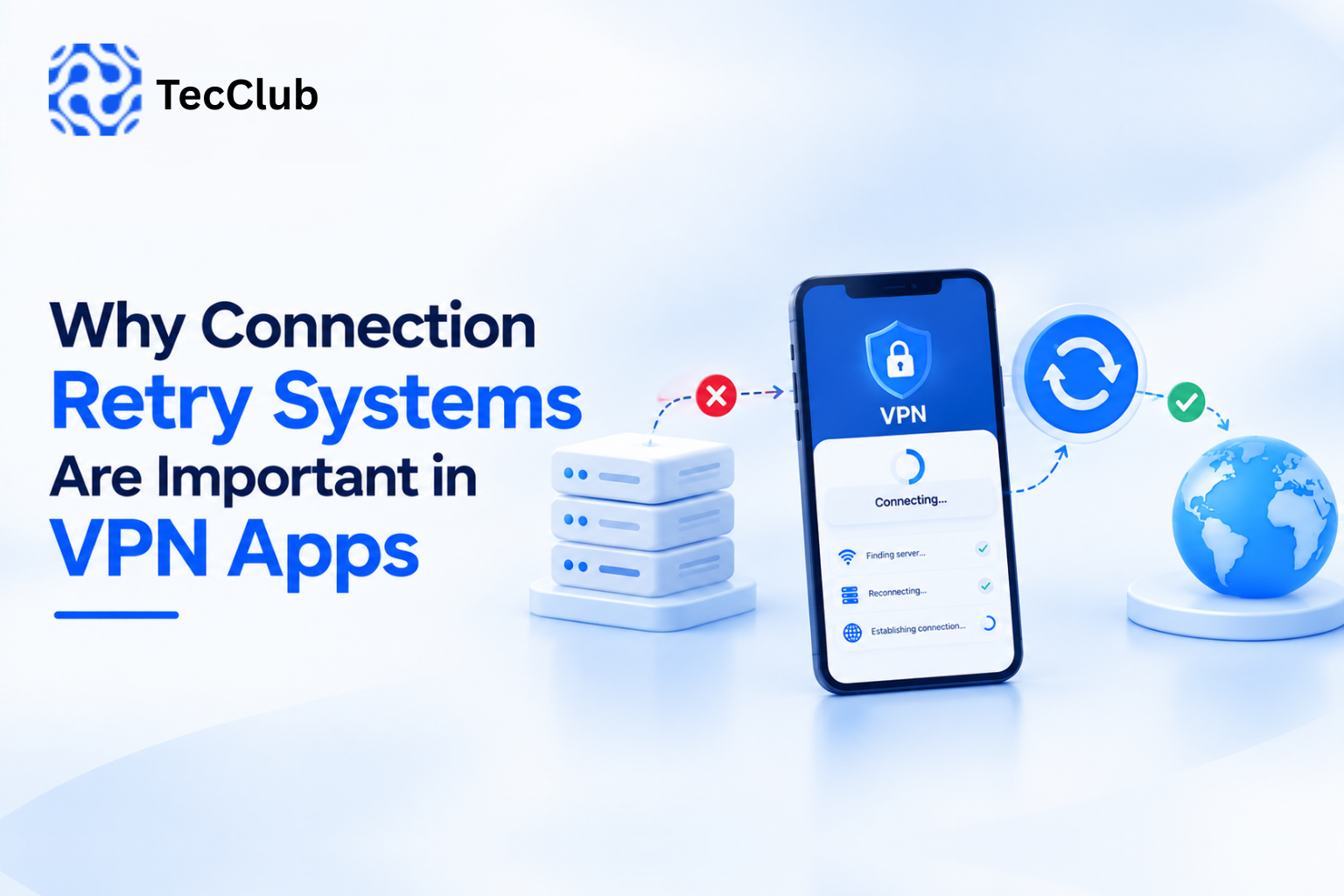
- “Connecting…”
- “Connected”
- “Reconnecting…”
No technical language—just clear, human updates.
Handling Messy Real-World Networks
In real life, networks are unpredictable.
Wi-Fi drops. Mobile data kicks in. Signals get weak.
Instead of letting the app feel broken, we make sure it:
- updates instantly
- shows what’s happening
- recovers smoothly
So even if the network is messy, the experience isn’t.
Speed Matters More Than You Think
A VPN app should never feel slow.
If the interface lags, users assume the VPN itself is slow—and that’s a problem.
So we keep things lightweight:
- fast UI rendering
- minimal delays
- smooth transitions
Frameworks like Flutter help us keep everything feeling quick and responsive.
Making Sure Everything Stays in Sync
There’s a lot happening behind the scenes—servers, connections, routing.
If the frontend isn’t synced properly, users might see the wrong status.
That’s why we:
- use real-time updates
- rely on event-based systems
- make sure what users see is always accurate
No guessing, no confusion.
Showing Just Enough (Not Too Much)
Things like server lists and speed can get technical fast.
But most users don’t want to analyze numbers—they just want a good connection.
So we simplify:
- “Recommended server”
- “Fast” or “Best option”
That’s usually all people need.
Letting the App Make Smart Choices
Protocols like WireGuard or OpenVPN are important—but not for the user to choose.
So instead of asking, we:
- decide automatically
- switch when needed
- optimize in the background
The best UX is when users don’t even realize decisions are being made.
Building Trust Without Explaining Everything
Users don’t need a technical breakdown of encryption.
They just need to feel safe.
So we show simple signals like:
- connection is secure
- VPN is active
- protection is on
Clear visuals = more confidence.
Making Background Work Feel Invisible
A VPN is always running—even when the app isn’t open.
But users shouldn’t have to think about that.
So we make sure:
- the UI stays updated
- notifications are helpful (not annoying)
- everything feels consistent
It just quietly does its job.
Keeping the Experience the Same Everywhere
Whether someone is using Android or iPhone, the app should feel familiar.
Same layout. Same flow. Same simplicity.
That consistency makes the app easier to trust and use.
What It All Comes Down To
At the end of the day, users don’t care about:
- how advanced your system is
- how many features you have
They care about one thing:
👉 “Does this feel easy and reliable?”
If yes—they stay.
If not—they leave.
How We See It at TecClub Technology
Our approach is simple:
Take something powerful… and make it feel effortless.
We focus on:
- clean, friendly design
- fast and smooth performance
- smart automation
- real-world usability
So users don’t have to figure anything out.
Final Thought
The best VPN apps don’t feel technical at all.
They feel:
- simple
- responsive
- trustworthy
Like something that just works.
At TecClub Technology, that’s exactly what we aim for—
technology you don’t have to think about, but can rely on every day.